In this series: North Carolina Chronic Absenteeism 2024-25.
Charlotte-Mecklenburg Schools has 72,907 chronically absent students. That single number is larger than the total enrollment of all but eight districts in North Carolina. It represents 18.6% of every chronically absent student in the state, concentrated in one school system in one city.
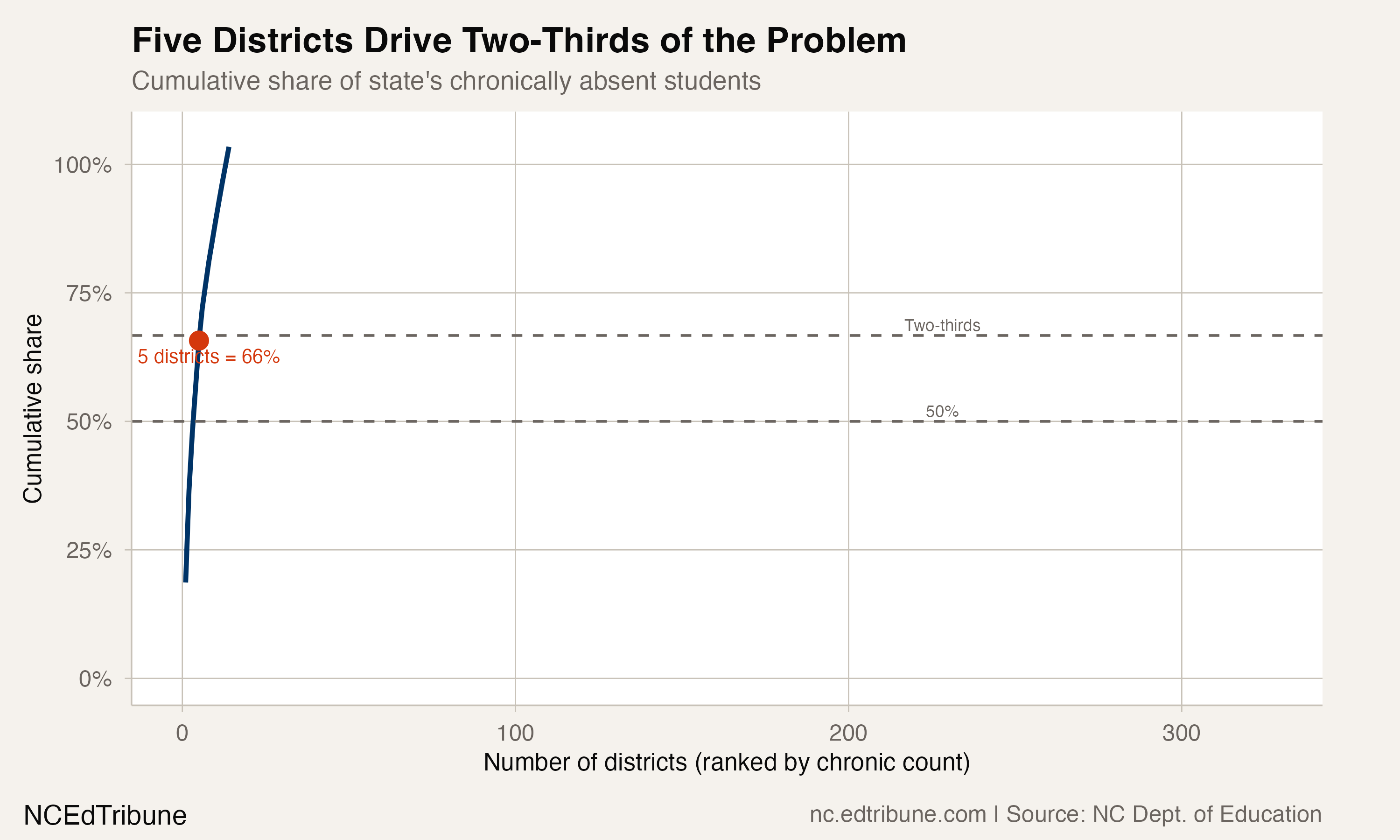
Add Wake County (69,914), Guilford County (43,922), Cumberland County (35,262), and Winston-Salem/Forsyth (34,961), and five districts account for 256,966 of the state's 391,065 chronically absent students. That is 65.7%, two-thirds of the entire crisis, in five zip codes.
The arithmetic of concentration
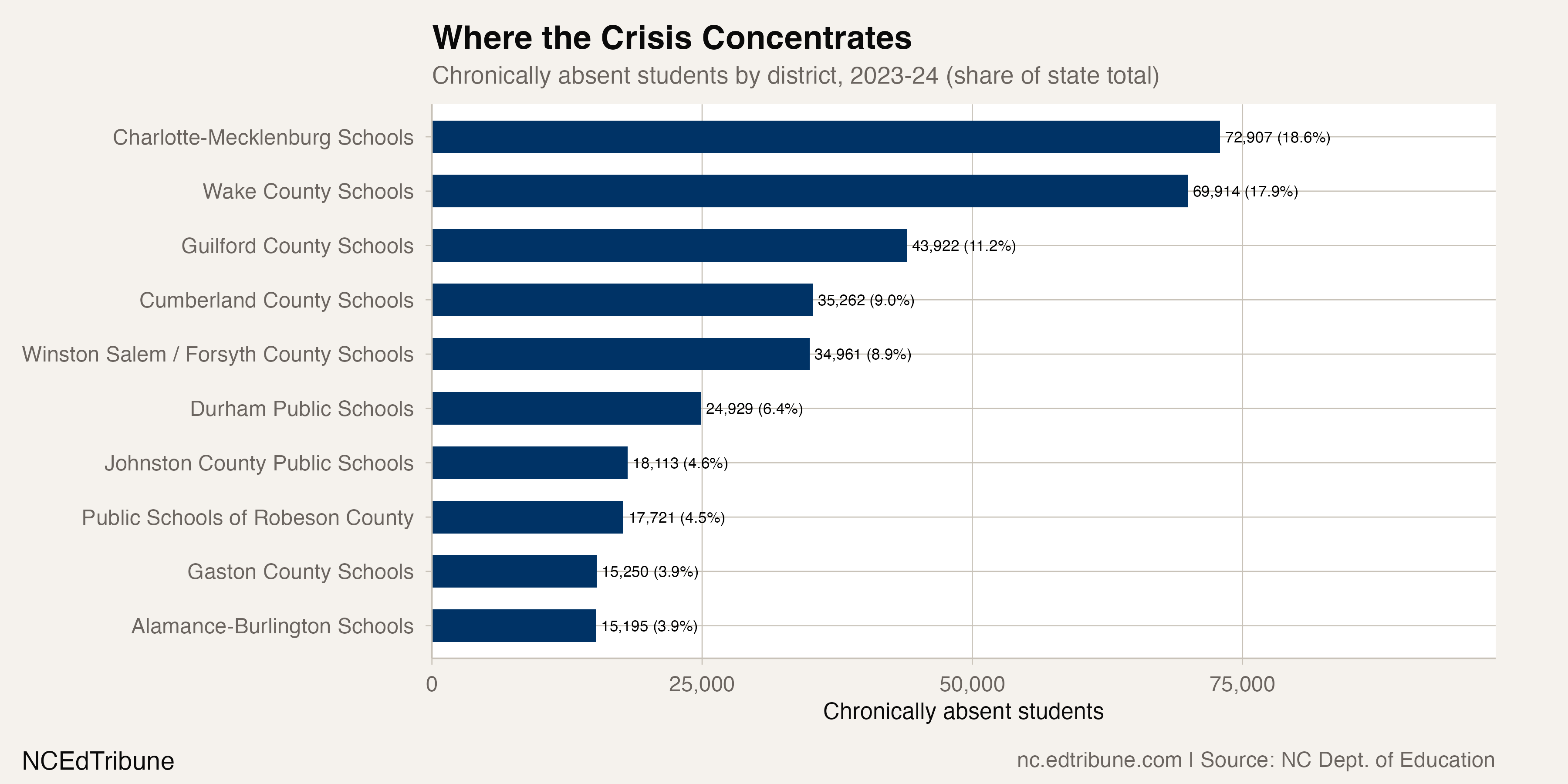
The concentration is not just about size, though size matters. The top five are also the five largest districts in the state. But the concentration exceeds what their enrollment share would predict. These five districts are the five largest in the state and account for 65.7% of chronic absence, meaning they are disproportionately contributing to the problem, not merely reflecting their size.
The top 10 districts, adding Durham (24,929), Johnston (18,113), Robeson (17,721), Gaston (15,250), and Alamance-Burlington (15,195), account for 89% of the state's chronically absent students. The remaining 300+ districts, from rural counties with a few hundred students to mid-size suburban systems, share the other 11%.
CMS alone outweighs most districts entirely
The scale of Charlotte-Mecklenburg's chronic absence problem deserves its own context. The district's 72,907 chronically absent students approach the total enrollment of Johnston County (78,443), the state's seventh-largest district. CMS has more chronically absent students than 98% of North Carolina's districts have students of any kind.
CMS's chronic rate, 23.9%, is actually below the state average of 25.0%. The problem is sheer volume: when a district enrolls 305,187 students, even a below-average rate produces an enormous count. Wake County faces the same dynamic with a 20.5% rate, one of the lower rates among large districts, but 69,914 chronically absent students because 340,573 are enrolled.
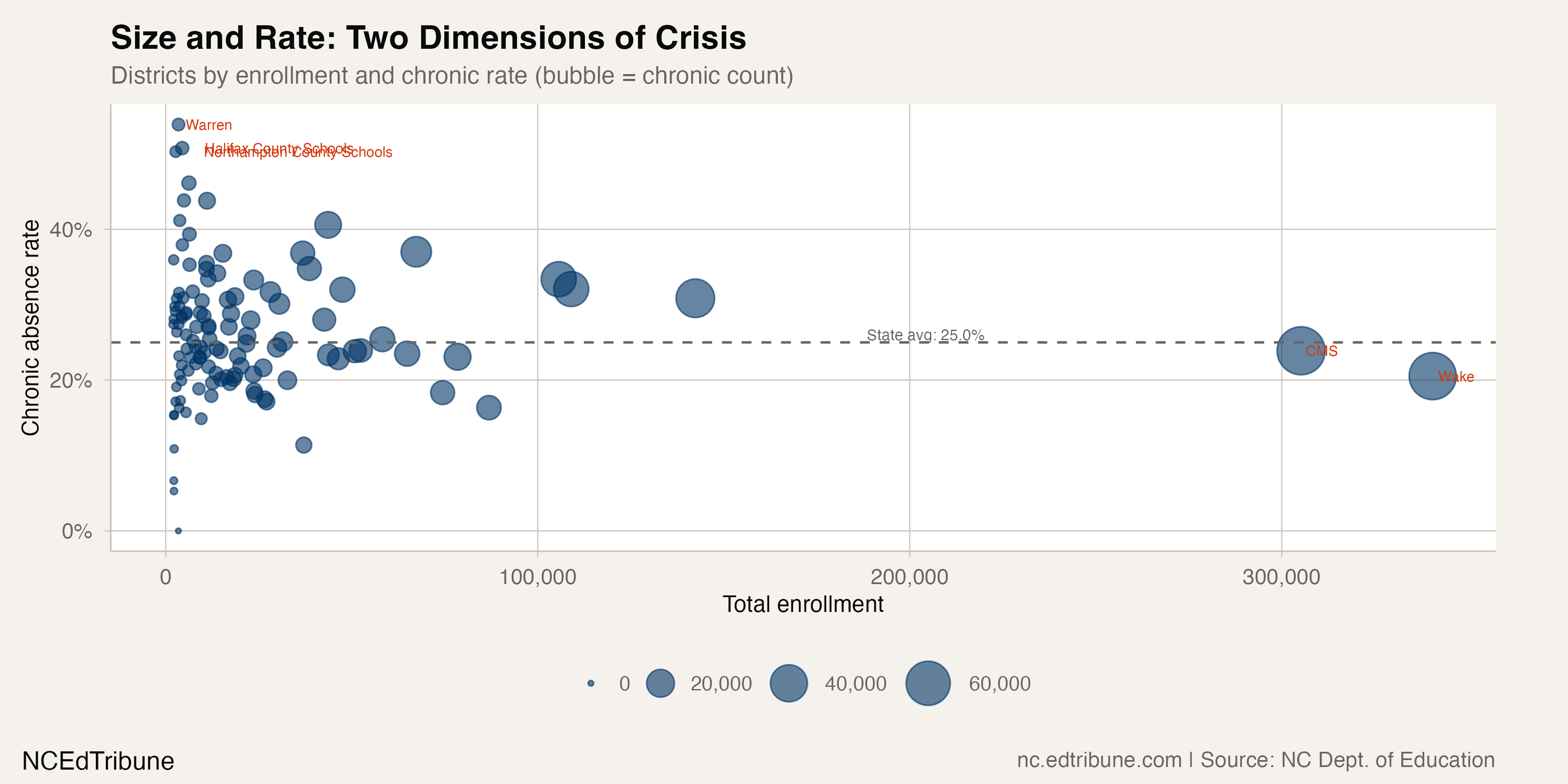
The districts where the rate is both high and the enrollment is large drive the most total absence. Cumberland County combines a 33.4% rate with 105,633 students. Guilford County is at 30.9% with 142,361 students. These are districts where rate and scale compound each other.
What concentration means for policy
The extreme concentration carries a counterintuitive policy implication. Statewide initiatives, from awareness campaigns to attendance tracking software, spread resources across 300-plus districts. But the data suggests that targeted interventions in five districts alone could move the state's chronic absenteeism needle more than any statewide policy change.
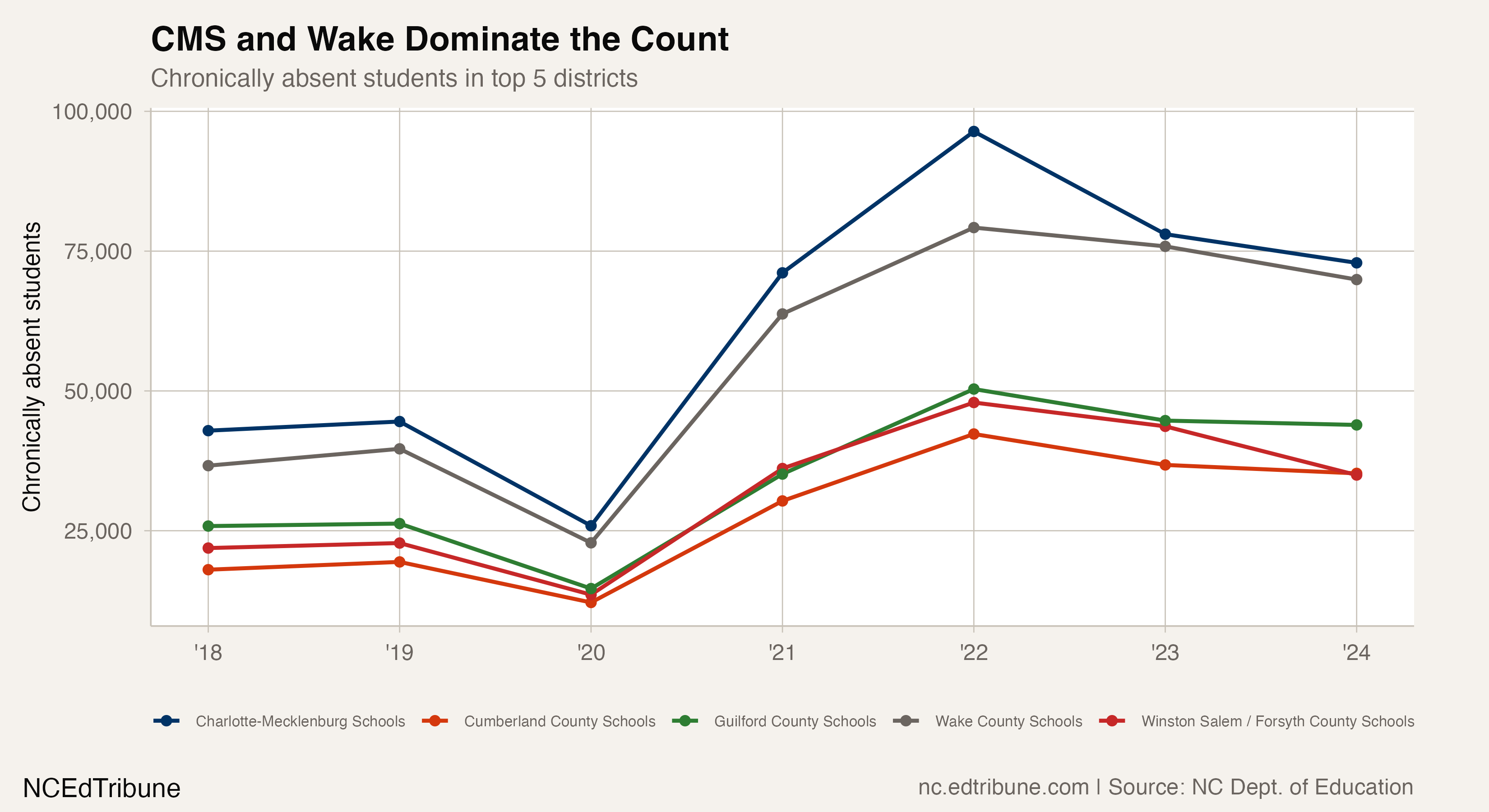
If CMS and Wake County each cut their chronic counts by 20%, the state would gain back more than 28,000 students, an improvement larger than most districts' total enrollment. The same 20% reduction across the other 195+ districts with chronic absence above pre-COVID levels would yield far less total movement.
This is not an argument against statewide policy. It is an argument for proportional investment. North Carolina's chronic absenteeism crisis is, at its core, a five-district problem masquerading as a statewide one. Until CMS, Wake, Guilford, Cumberland, and Winston-Salem/Forsyth materially reduce their chronic counts, the state's aggregate number will barely move.
Detailed code that reproduces the analysis and figures in this article is available exclusively to EdTribune subscribers.
Discussion
Sign in to join the discussion.
Loading comments...