Correction (April 22, 2026, updated June 4, 2026): An earlier version of this article relied on district-level enrollment and chronic absence figures that were double-counted because of a data processing error. The error inflated every district's enrollment, which pushed dozens of small districts above the 500-student threshold used to define the analysis pool and made six of those small districts appear to have recovered. With the enrollment figures corrected, 112 districts have 500 or more students, and none of them has returned to its pre-COVID chronic absence rate. All counts and the central finding have been corrected.
Of the 112 North Carolina school districts with 500 or more students, not one has returned to its pre-pandemic chronic absenteeism rate. Every one of them remains above where it was in 2018-19, most of them significantly so.
The finding reframes what "recovery" means in North Carolina's attendance crisis. The statewide rate dropped from a peak of 31.2% to 25.0%, a genuine improvement. But that aggregate number masks a complete absence of recovery at the district level: every district with 500 or more students still has a higher chronic absence rate than before COVID. The attendance crisis is not concentrated in a handful of struggling systems. It is everywhere.
No size category has recovered
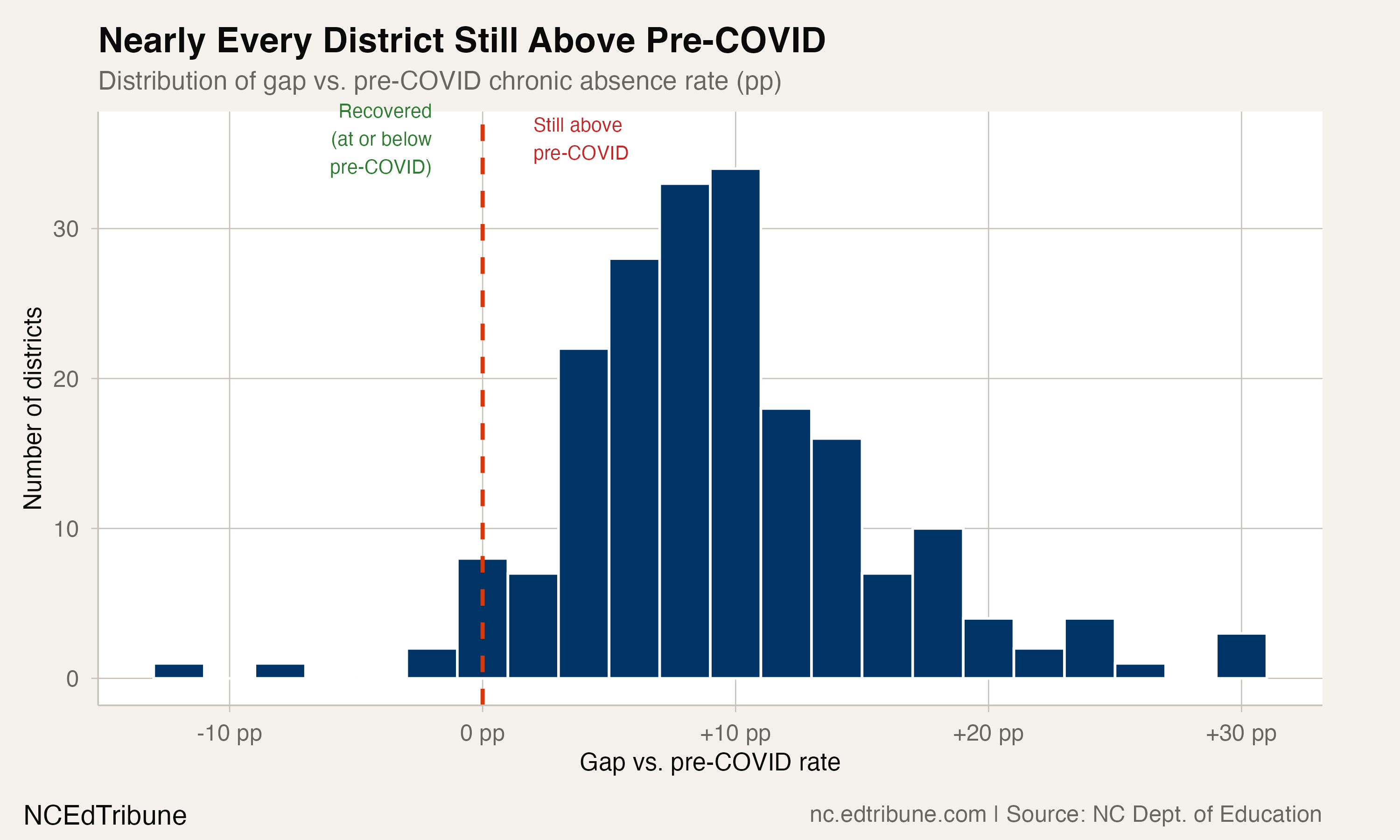
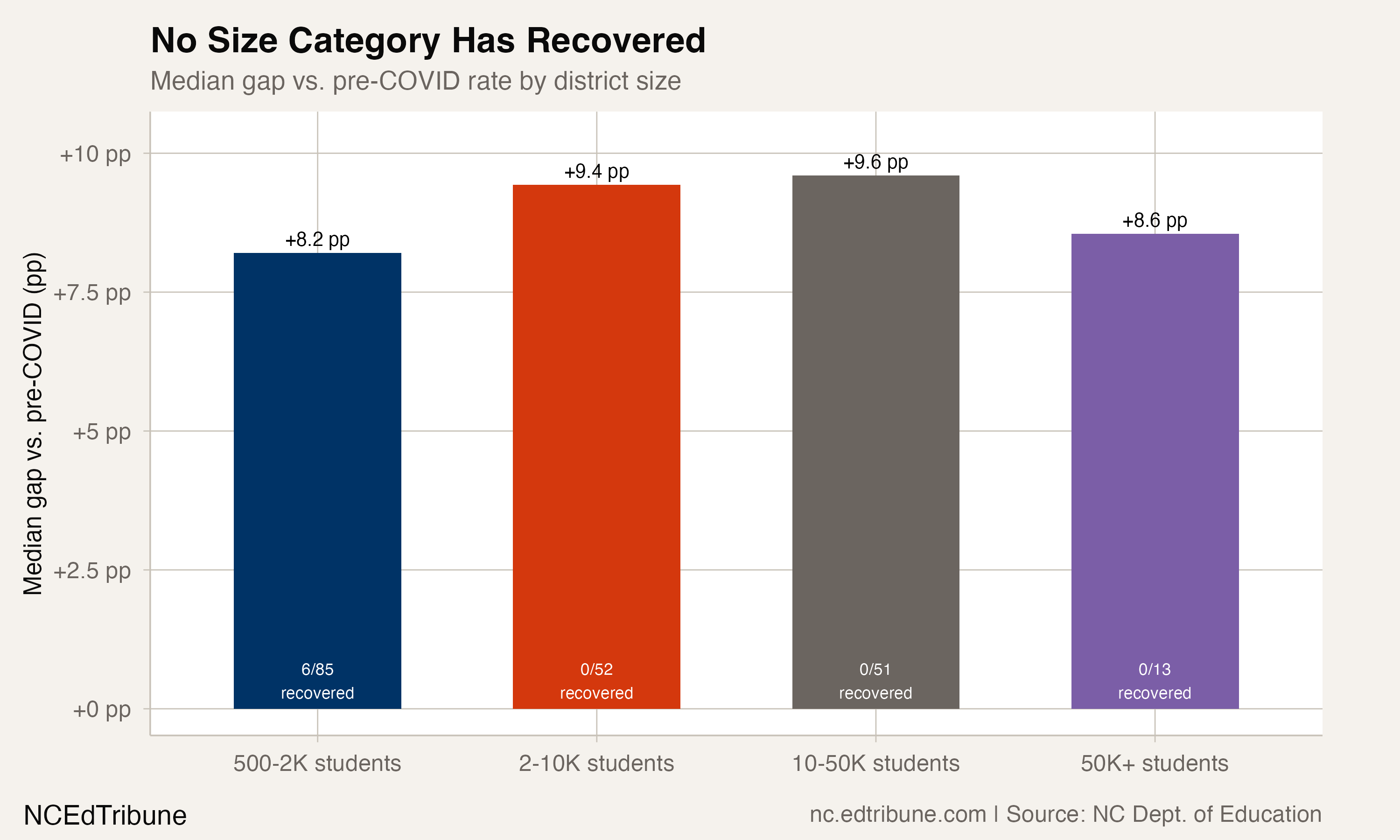
The distribution of district-level gaps tells a bleak story. The median district is roughly 9.5 percentage points above its pre-COVID chronic absence rate. Districts of every size carry similar burdens: small districts (500 to 2,000 students) have a median gap of 9.9 points, the largest districts (50,000+) a median gap of 10.5 points. The crisis does not discriminate by size, location, or resources.
Not a single district in any size category has recovered. The smallest systems, where a counselor can know which students stopped coming and a principal can make home visits, have closed the gap no more successfully than the Wake Counties and Charlotte-Mecklenburgs of the state.
The state's largest districts are 8 to 18 points above baseline
Wake County Schools, the state's largest district with 168,295 students, went from a 12.7% chronic absence rate before the pandemic to 20.6% in 2023-24, a 7.8-point gap. Charlotte-Mecklenburg, the second largest, jumped from 15.5% to 24.0%. Both improved from their post-COVID peaks but remain roughly 60% above their pre-pandemic baselines.
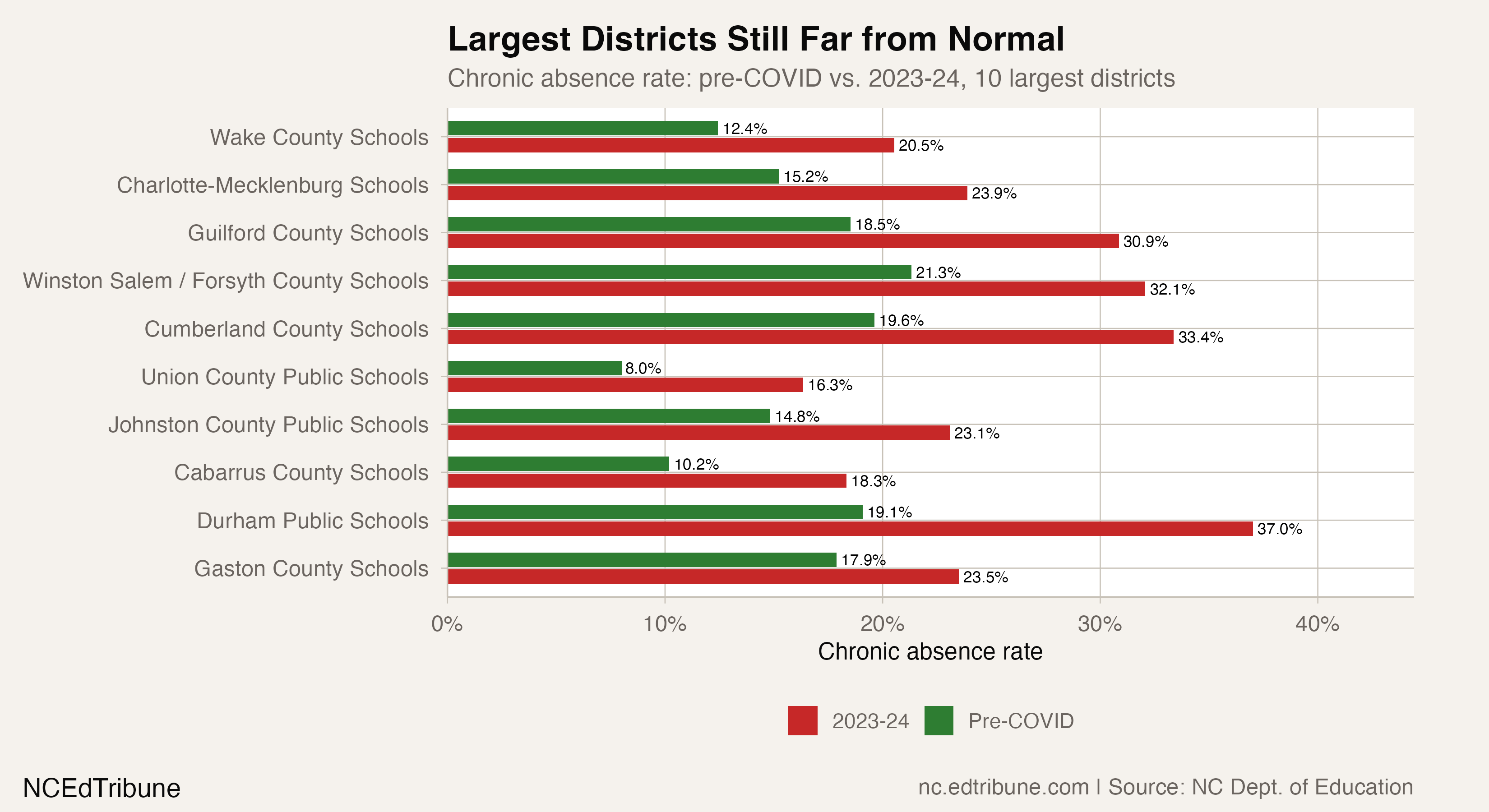
Durham Public Schools stands out even in this grim landscape. The district's chronic rate nearly doubled from 19.3% to 37.2%, a 17.8-point gap that is the largest among any district in the state's top 10. Cumberland County is not far behind at 13.3 points above its pre-COVID level, with one in three students now chronically absent.
The consistency is what makes the finding so striking. Not a single district among the 10 largest has returned to normal. Not the affluent suburban systems, not the mid-size county districts, not the urban centers. Whatever happened to attendance norms during the pandemic happened to all of them.
The districts furthest from recovery
At the other end of the spectrum, some districts have gaps that suggest a fundamentally different attendance reality than what existed before 2020.
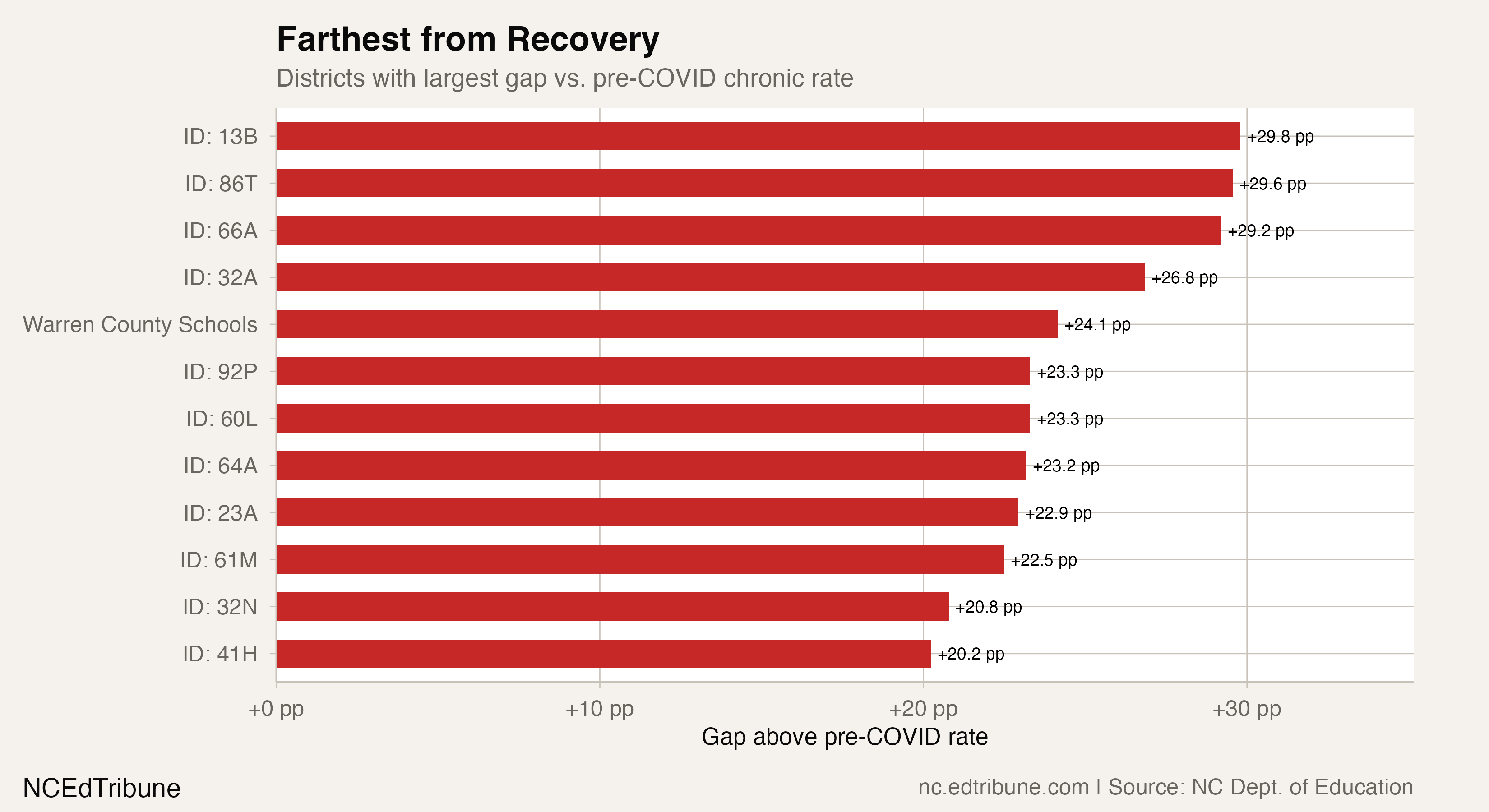
Warren County Schools, a 1,718-student district in northeastern North Carolina, went from a 29.7% chronic rate to 53.9%, a 24-point increase. More than half its students now miss at least 18 days per year. Northampton County, just to the east, jumped from 31.7% to 50.5%. Both are part of the state's historically disadvantaged rural northeast corridor, where poverty rates are among the highest in the state and transportation barriers compound every other attendance challenge.
Cherokee County Schools, in the state's far western mountains, went from 20.4% to 39.3%, a 19-point gap. Granville County, north of Durham, saw a comparable jump, from 16.2% to 34.2%.
What recovery would actually require
Small districts hold a structural advantage when it comes to attendance. In a system with 560 or 1,000 students, individual interventions can reach a meaningful share of chronically absent families. A school counselor knows which students stopped coming. A principal can make home visits. And yet not one of them has closed the gap to its pre-COVID rate either, which underscores how stubborn the problem has become.
That model does not translate to Wake County's 168,295 students or Charlotte-Mecklenburg's 149,930. For districts of that scale, returning 20.6% to 12.7% means finding attendance solutions for roughly 13,000 additional students who were not chronically absent before the pandemic. That is a logistics problem as much as an educational one: identifying the barriers for each student, whether transportation, health, safety, housing instability, or disengagement, and addressing them case by case.
The total absence of recovery is not a measure of effort. Many districts have launched attendance campaigns, hired attendance coordinators, and invested in early warning systems. The pattern measures how far the problem exceeds the available tools. When not one district has closed the gap, the lesson is less about any single playbook than about scale: what works for 1,000 students may not work for 100,000, and so far it has not worked at either size.
Detailed code that reproduces the analysis and figures in this article is available exclusively to EdTribune subscribers.
Discussion
Sign in to join the discussion.
Loading comments...