In the fall of 2022, the chronic absenteeism number that landed on desks at the North Carolina Department of Public Instruction was staggering: 483,371 students, nearly a third of all children in public schools, had missed at least 18 days. Two years later, that number has dropped to 391,065. The improvement is real. It is also losing momentum at precisely the wrong time.
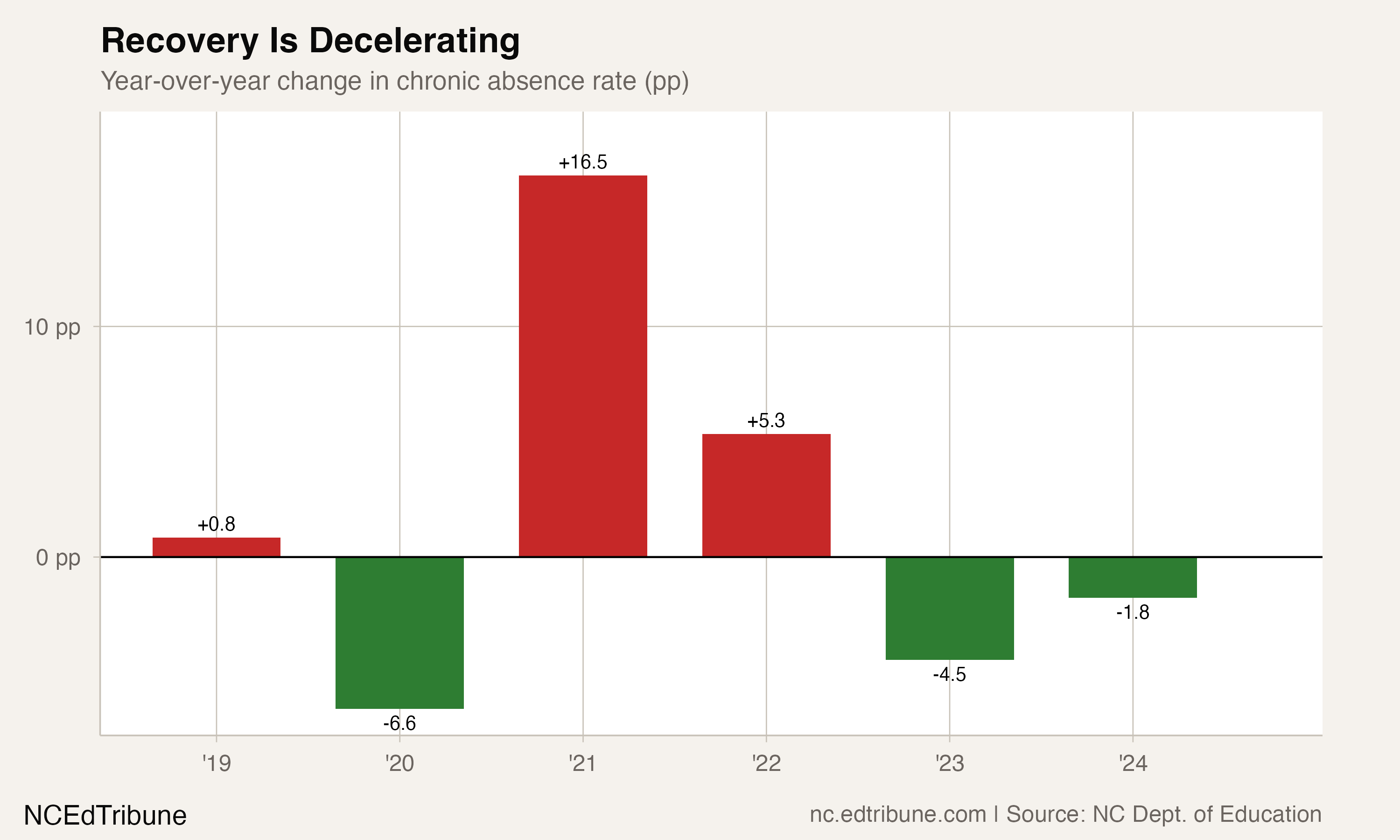
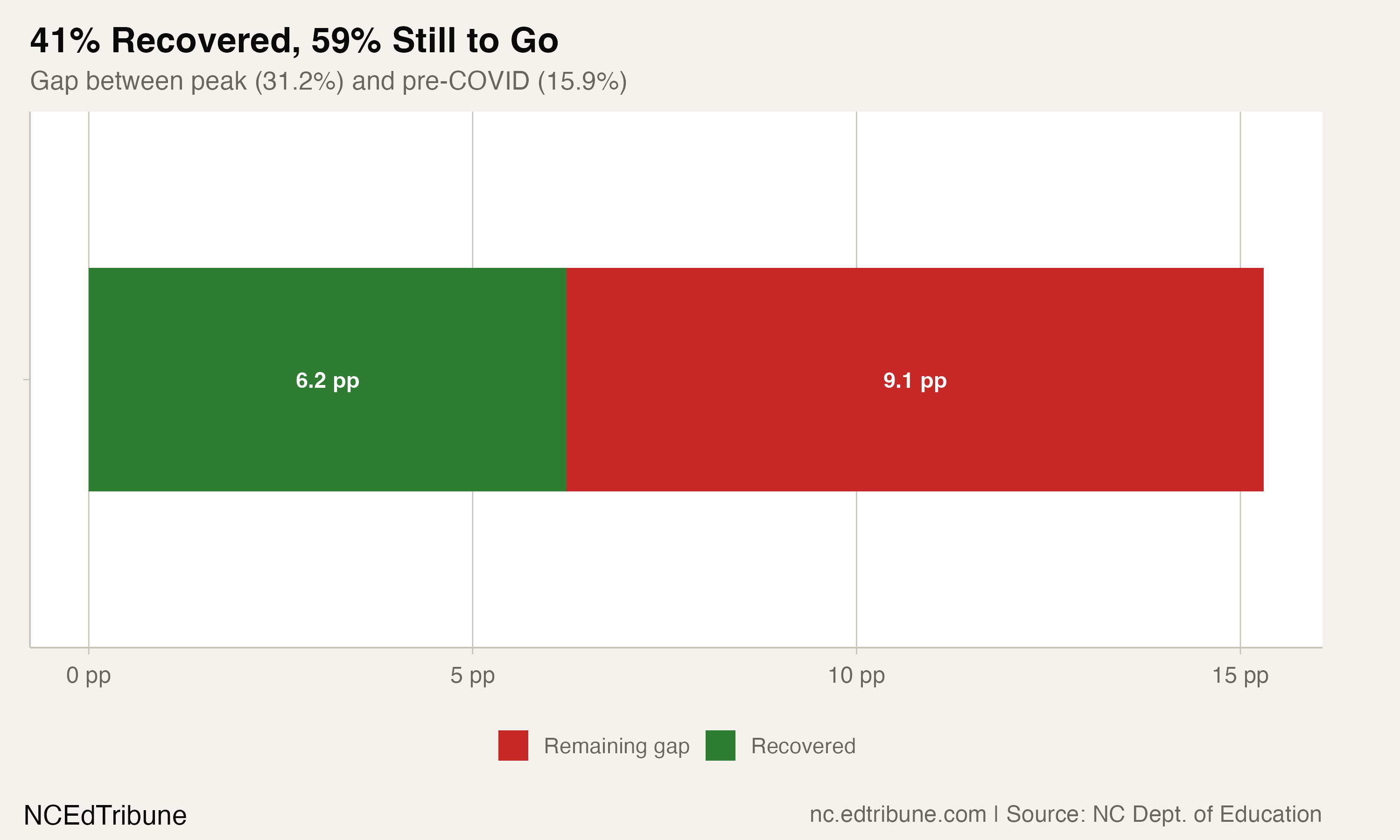
North Carolina's chronic absence rate fell from 31.2% at its peak to 25.0% in 2023-24, which means one in four students is still missing roughly a month of instruction every year. The state clawed back 4.5 percentage points in 2022-23, then managed only 1.8 points the following year. That deceleration matters: at the slower pace, the state will not return to its pre-pandemic baseline of 15.9% until at least 2029. The state's own target of 11% by 2030 would require cutting the rate by about 2.3 points per year, a pace North Carolina has never sustained.
The easy recoveries may be over
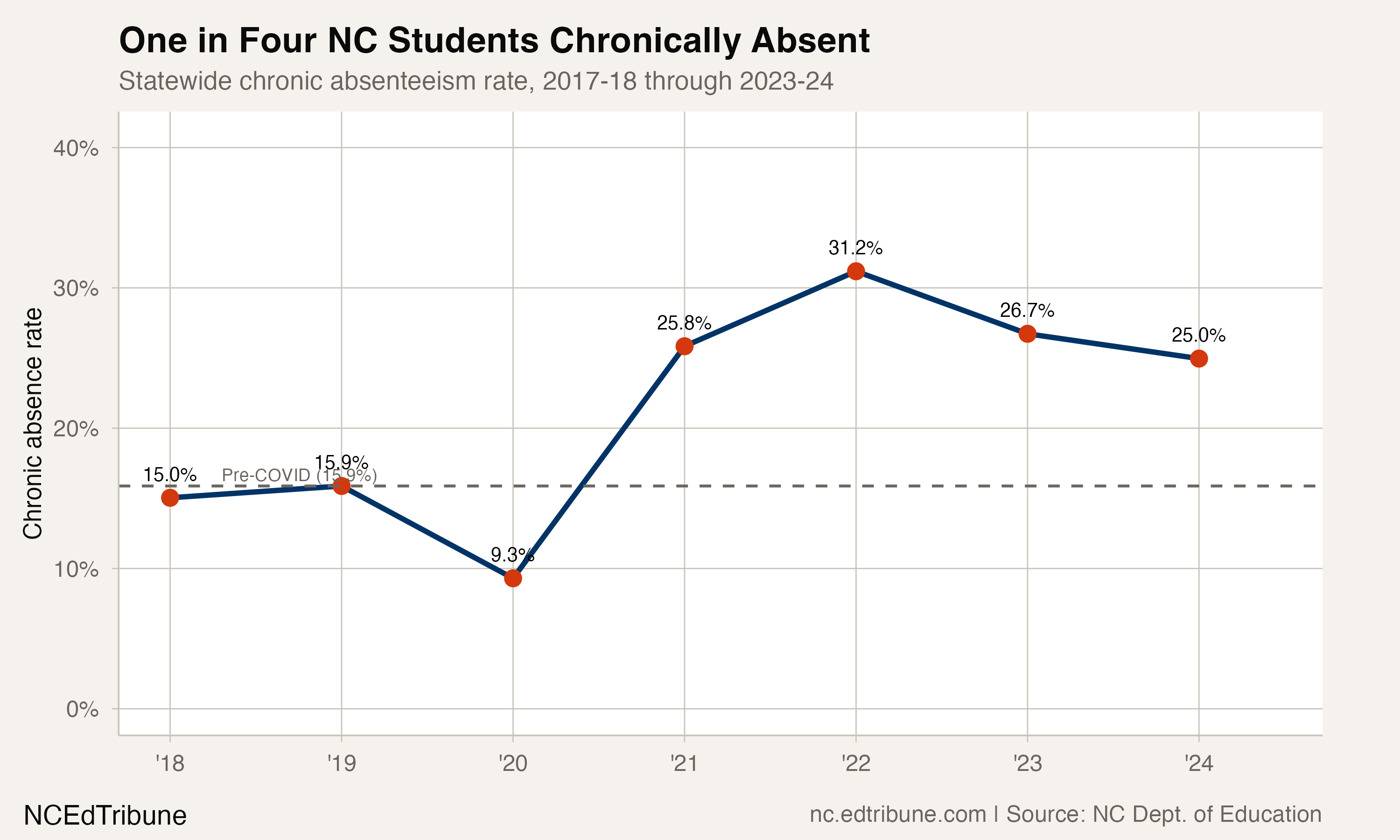
The trajectory since 2018 tells a familiar story with an unfamiliar ending. Before COVID, chronic absenteeism hovered around 15-16%, stable enough that it rarely made headlines. The pandemic blew the rate to 25.8% in 2020-21, then to a peak of 31.2% in 2021-22, even as schools fully reopened. The initial recovery in 2022-23, a 4.5-point drop, likely captured the students who had simply fallen out of habit during remote learning and returned to regular attendance once normalcy resumed.
The 1.8-point improvement in 2023-24 suggests that pool of "easy" recoveries has been largely exhausted. What remains is a harder problem: students whose absenteeism has become entrenched.
Research from UNC's Education Policy Initiative at Carolina underscores this concern. The share of students who were chronically absent in all three post-pandemic years quadrupled from 2.4% to 9.6% compared to the three pre-pandemic years. These are not students who occasionally miss a week for illness. They are students with deep, persistent attendance barriers, and they will require interventions far more intensive than attendance letters and robocalls.
149,673 more students than before
The percentage-point framing, while useful for tracking trends, obscures the human scale. In raw numbers, 391,065 North Carolina students were chronically absent in 2023-24. That is 149,673 more than the 241,392 who were chronically absent in 2018-19. Put differently: North Carolina has recovered 41% of the ground lost during the pandemic, but there are still enough additionally absent students to fill every seat in the Charlotte-Mecklenburg school system.
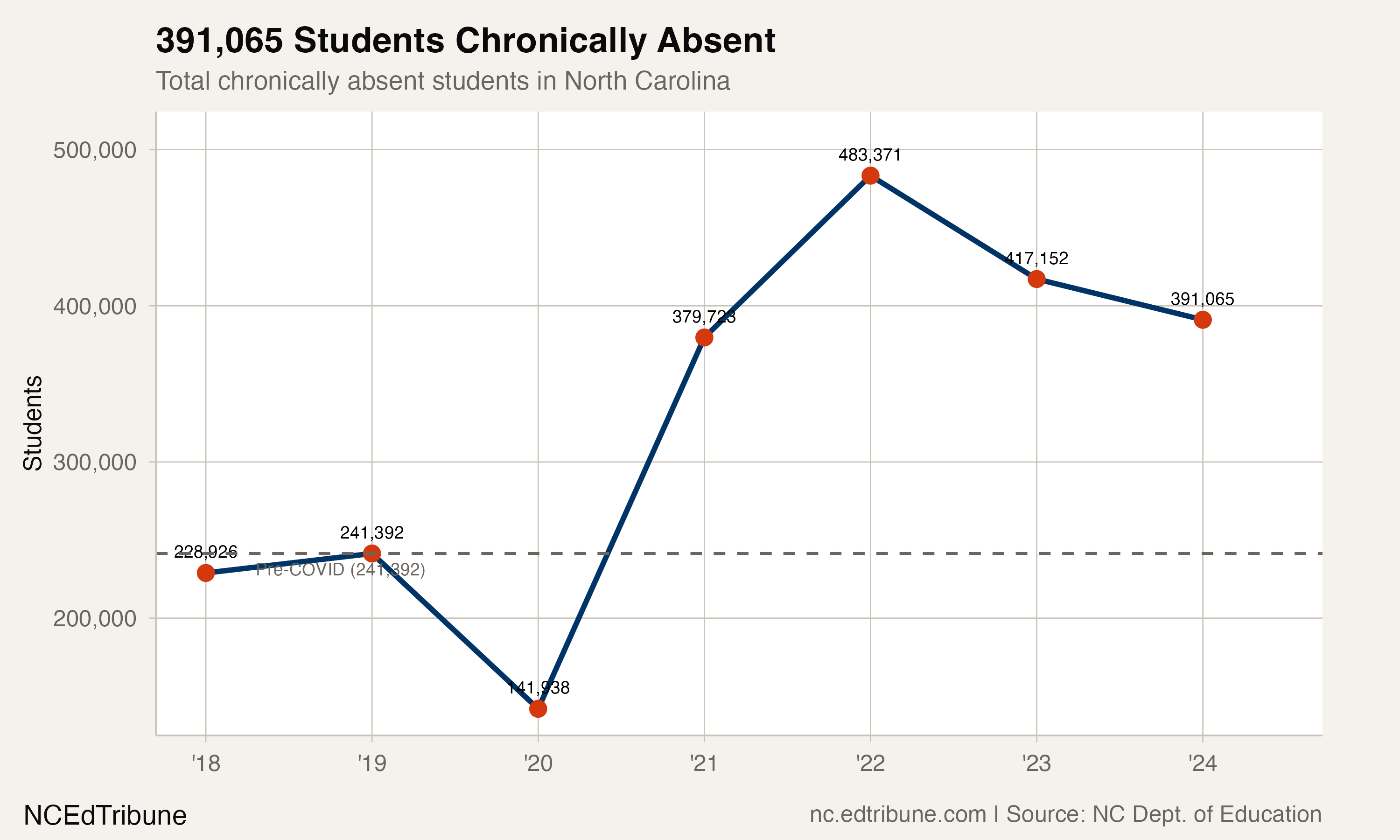
The state's enrollment actually grew slightly over this period, from 1,519,962 to 1,566,774, meaning the rising chronic count is not an artifact of a larger denominator. More students are enrolled and more of them are missing school.
Who is missing school
The crisis does not fall evenly. Native American students have the highest chronic absence rate at 40.9%, meaning two in five miss at least 18 days per year. Black students follow at 31.5%, economically disadvantaged students at 34.0%, and students with disabilities at 32.4%. Asian students, at 11.3%, are the only subgroup that meets the state's 11% target.
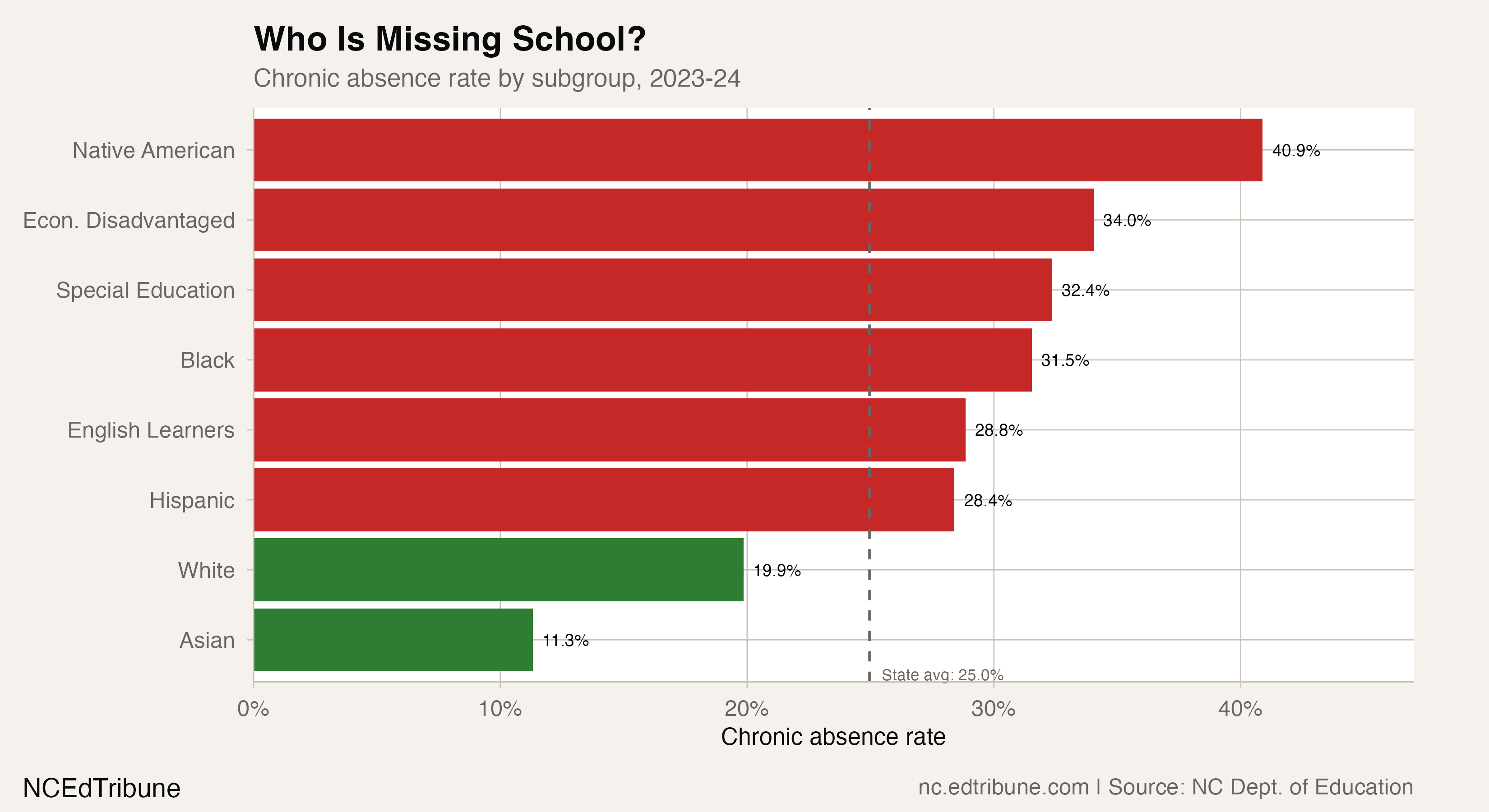
English learners present a particularly troubling reversal. Before the pandemic, EL students actually had a lower chronic absence rate than the state average, 14.8% versus 15.9% in 2019. By 2024, they had flipped to 28.8%, nearly 4 points above the overall rate. Whatever protective factors once kept EL attendance strong, whether family culture, school engagement programs, or community networks, COVID disrupted them and they have not returned.
The 11% target and what it would take
North Carolina's AttendNC Counts initiative set an ambitious goal: reduce chronic absenteeism to 11% by 2030. That would mean cutting the rate by 14 points in six years, or roughly 2.3 points per year. The state managed 4.5 points in its best recovery year and 1.8 in its most recent. The math is not encouraging.
The 11% target would require not just maintaining the current pace of improvement but accelerating it, the opposite of what the data shows. It would also require closing the gap for the hardest-to-reach populations: the 9.6% of students who have been chronically absent every post-pandemic year, the rural districts where transportation remains a barrier, and the subgroups where rates exceed 30%.
"Some students are experiencing especially deep and persistent levels of absenteeism, and these students may face deeper underlying challenges to attendance and require more intensive intervention to recover." -- Swiderski, Fuller, and Bastian, UNC EPIC (2025)
North Carolina's current toolkit was built for the students who came back on their own. The 391,065 who did not will need something different: more counselors, more transportation options, more school-based health clinics. The 2024-25 data will show whether the deceleration was a temporary plateau or the start of a permanent stall.
Detailed code that reproduces the analysis and figures in this article is available exclusively to EdTribune subscribers.
Discussion
Sign in to join the discussion.
Loading comments...