In 2006, barely half of Hispanic students in North Carolina graduated on time. The 52.3% rate placed them 21.2 percentage points behind white students, a gap wide enough to feel structural and permanent.
It wasn't.
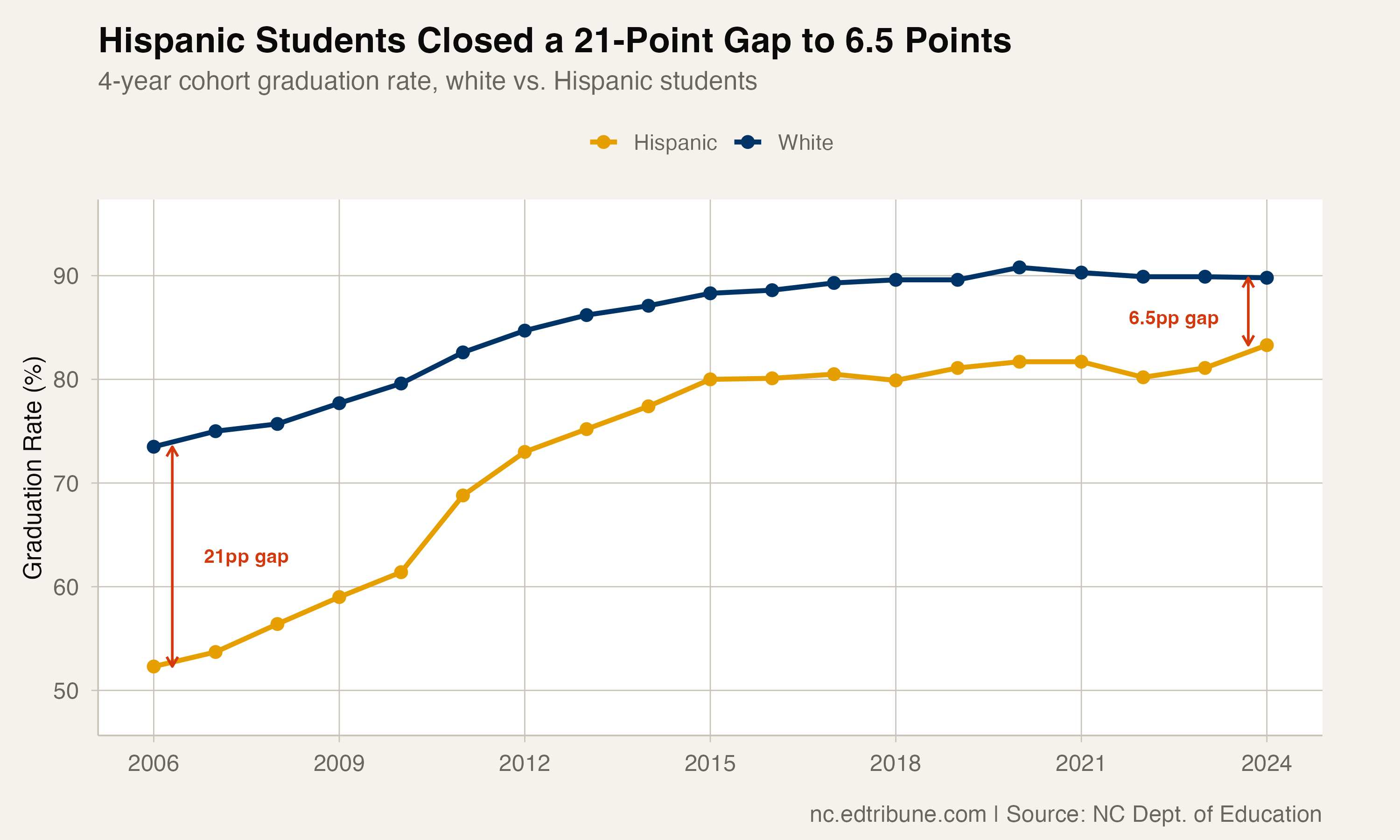
By 2024, the Hispanic graduation rate reached 83.3% — a 31.0 percentage point improvement that ranks among the largest gains of any subgroup in the state. The white-Hispanic gap has narrowed to 6.5 points, roughly a third of where it started.
Growth while growing
What makes the Hispanic graduation story remarkable is not just the rate improvement — it's that it happened while the population was exploding. The Hispanic graduation cohort has grown from 5,117 students in 2006 to 25,360 in 2024, nearly a fivefold increase.
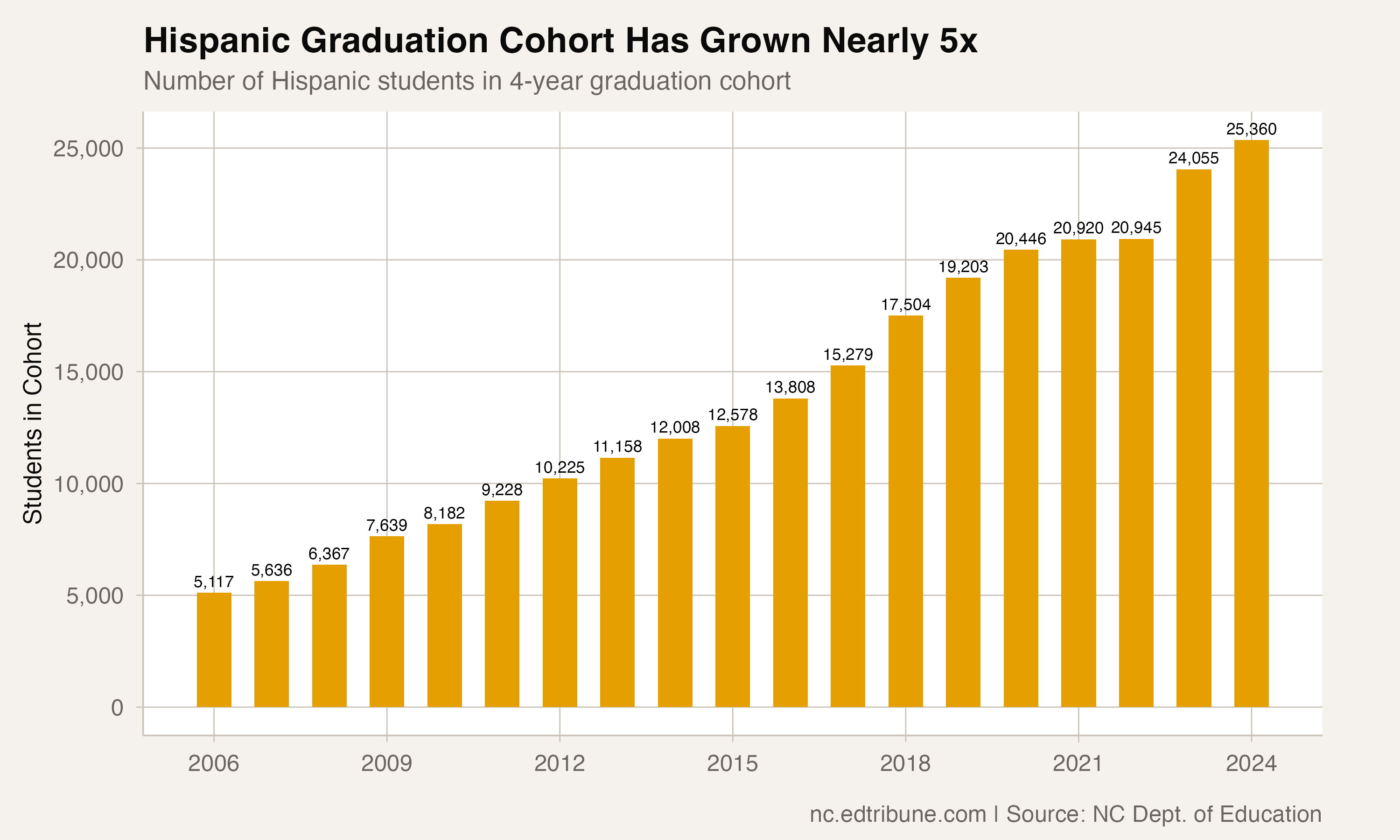
Maintaining quality while scaling is one of the hardest challenges in education. North Carolina's Hispanic population grew in every region of the state — in the Hog Belt towns of Duplin and Sampson counties, in the Charlotte and Raleigh metros, in rural western mountain communities that had no Spanish-speaking population a generation ago. The graduation rate climbed anyway.
The sheer scale of the cohort now matters for the state's bottom line. At 25,360 students, Hispanic graduates represent about 21% of all North Carolina graduates, up from less than 5% in 2006. Statewide graduation rate trends increasingly depend on Hispanic outcomes.
The seven-year plateau
The improvement was not linear. From 2006 to 2016, the Hispanic rate climbed steadily, reaching 81.1%. Then it stopped. For seven years — 2016 through 2023 — the rate oscillated between 79% and 81%, stuck in a narrow band that resisted every intervention.
The plateau period coincided with rapid growth in the cohort, which roughly doubled from 13,000 to 24,000 over those years. A charitable reading is that the system was absorbing enormous growth and merely keeping pace was an achievement. A less charitable reading is that the state's support systems hit a ceiling.
The 2024 breakout
In 2024, the rate jumped 2.2 percentage points to 83.3% — the largest single-year gain in nearly a decade and the first time the rate broke decisively above the 81% ceiling. Whether this represents a genuine breakthrough or a one-year fluctuation will only become clear with 2025 data.
The 2024 jump coincided with the Hispanic cohort exceeding 25,000 for the first time. If the gain holds, it would suggest that whatever was constraining the rate through the plateau period has been overcome.
Where the gap remains
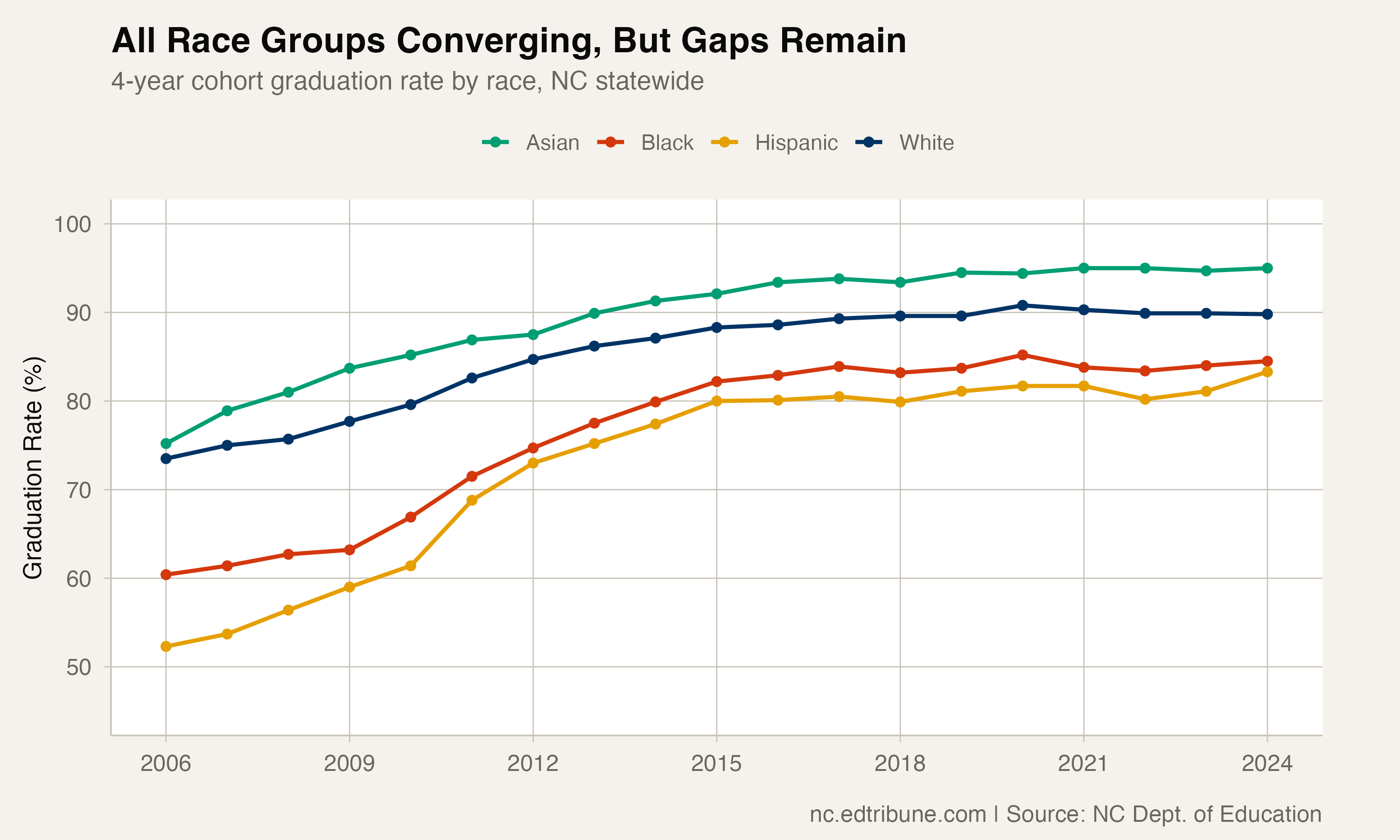
The remaining 6.5-point gap with white students — white at 89.8%, Hispanic at 83.3% — translates to roughly 1,650 Hispanic students per year who would graduate at white rates. Closing it completely would require sustained annual improvement of about 1 point per year, a pace the plateau period suggests is not automatic.
English language proficiency is a factor but not the whole story. The limited English proficient (LEP) graduation rate is 73.0%, and a significant share of the Hispanic cohort is classified as LEP. But many Hispanic students in North Carolina are third- or fourth-generation Americans fully proficient in English. The gap reflects a mix of language barriers, economic disadvantage, and first-generation college-going challenges that vary enormously across the state's diverse Hispanic communities.
Detailed code that reproduces the analysis and figures in this article is available exclusively to EdTribune subscribers.
Discussion
Sign in to join the discussion.
Loading comments...