Correction (April 22, 2026): District-level enrollment and chronic absence counts in this article were corrected after a data processing error was identified. Chronic absence rates were not affected.
Correction (July 23, 2026): An earlier version described the 21,244-student increase in the English learner population as a two-year change between 2022 and 2024. It is a single-year change between 2023 and 2024, and the fastest single-year expansion in the data.
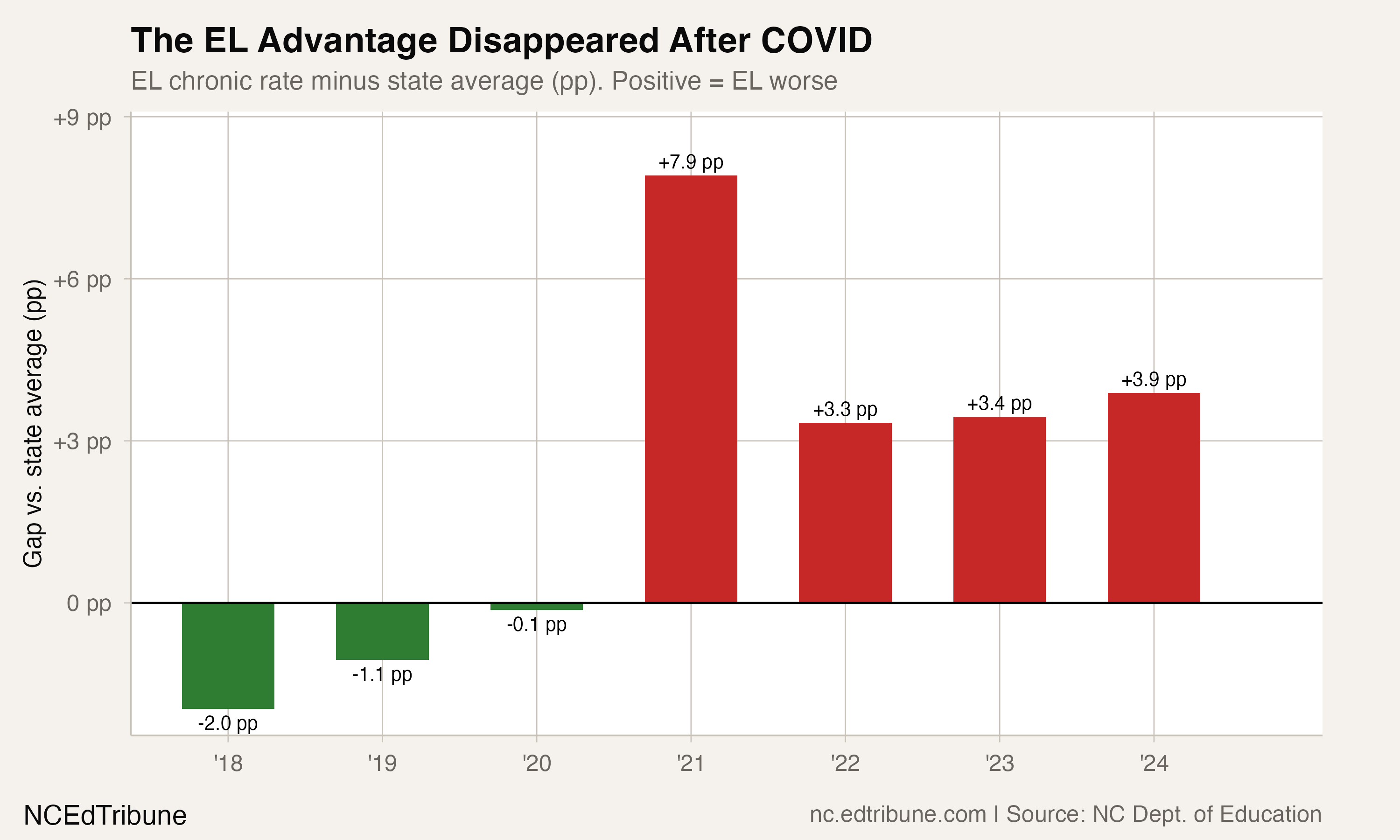
Before the pandemic, English learners in North Carolina had a chronic absenteeism rate of 14.8%, more than a full percentage point below the 15.9% state average. They were, by this measure, one of the better-attending student populations. By 2023-24, the relationship had inverted completely: EL students are now 3.9 points above the state average, with a 28.8% chronic rate compared to 25.0% overall.
The reversal is one of the most consequential attendance shifts in North Carolina's post-pandemic data, because it happened to a population that is simultaneously growing. EL enrollment climbed from 126,534 in 2019 to 174,923 in 2024, a 38% increase. The combination of a rising chronic rate and a growing population means 50,460 English learners were chronically absent in 2023-24, up from 18,770 before COVID, a 169% increase.
The crossover
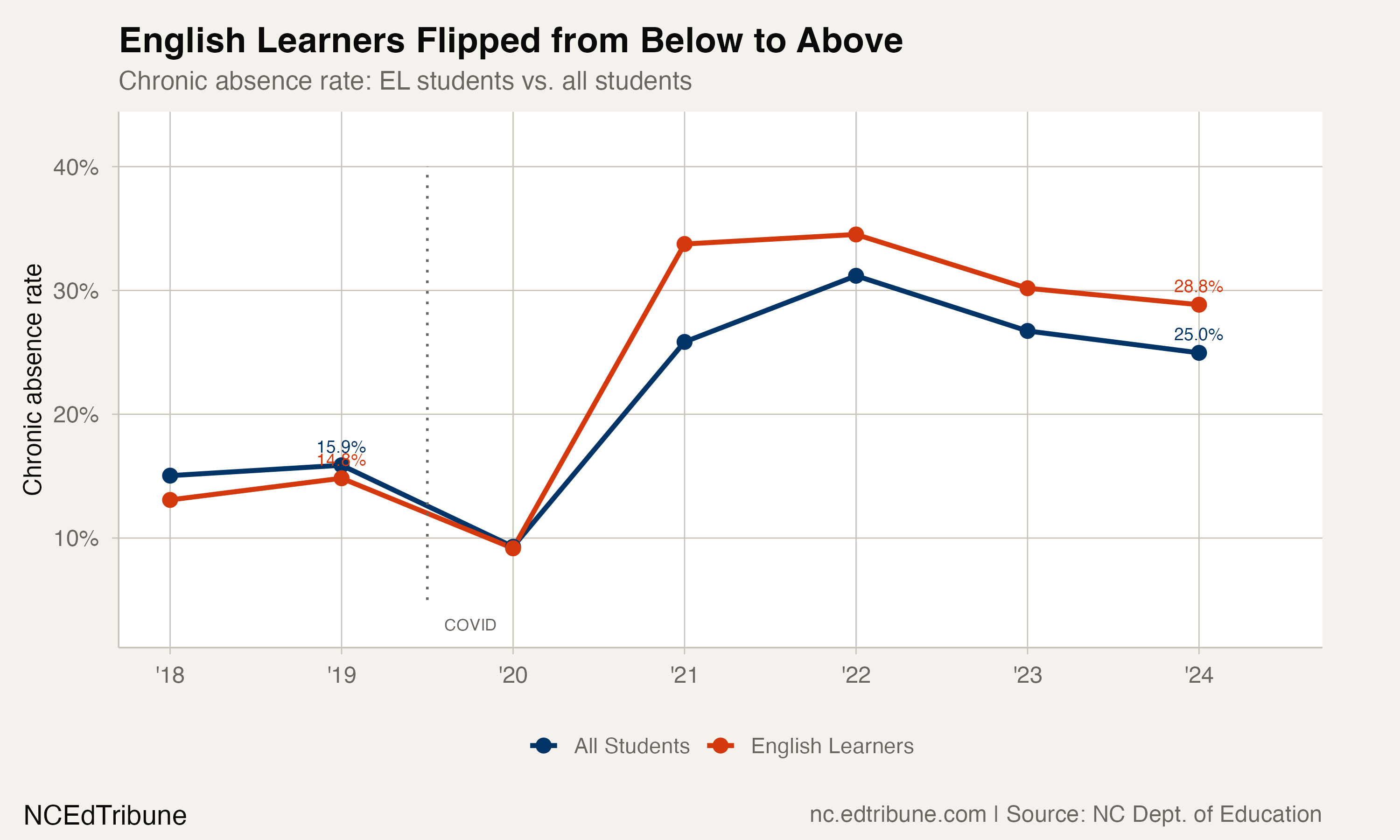
The crossover happened in 2020-21, when schools reopened after COVID closures. English learners' chronic rate leapt from 9.2% to 33.8%, a 24.6-point increase that was far steeper than the 16.5-point jump for all students. Whatever protective factors had kept EL attendance strong, they broke during the pandemic and have not reassembled.
Before COVID, several plausible factors could explain the EL attendance advantage: immigrant families often place high value on education as a path to opportunity, EL program structures provide built-in community and support networks at school, and many EL students attend schools with dedicated bilingual staff who build relationships with families.
The pandemic disrupted each of these. Remote learning was particularly inaccessible for families with limited English proficiency. School-based EL programs that had served as community anchors were shuttered. When schools reopened, the relationships between bilingual staff and families had frayed, and rebuilding them has proved slower than restoring attendance for the general population.
Now tracking with other at-risk groups
Before COVID, EL students had a distinctly different attendance pattern from other special populations. Special education students and economically disadvantaged students were consistently above the state average. English learners were below it. That separation no longer exists.
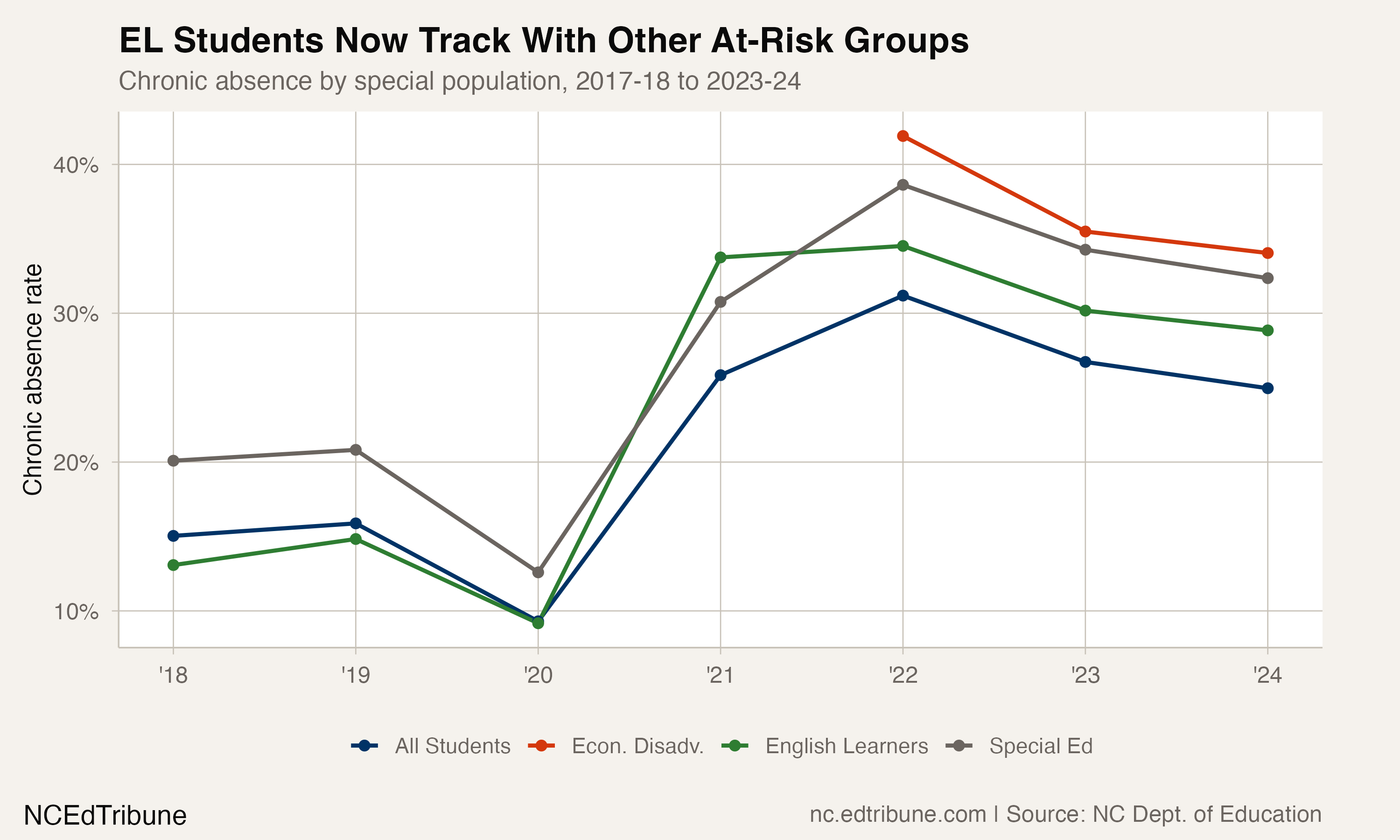
In 2023-24, EL students (28.8%) are in the same band as special education students (32.4%) and economically disadvantaged students (34.0%), all well above the state average. The pre-COVID pattern, where EL students attended at higher rates despite facing many of the same socioeconomic barriers, has been erased.
The timing raises an additional concern. North Carolina's EL population grew by 21,244 students between 2023 and 2024, the fastest single-year expansion in the data. Many of these new English learners are recent arrivals who may face additional attendance barriers: unstable housing, unfamiliarity with school systems, and in 2024-25, heightened immigration enforcement concerns that Charlotte-Mecklenburg Schools reported were driving a 9.6% increase in Hispanic student absences.
50,460 students and counting
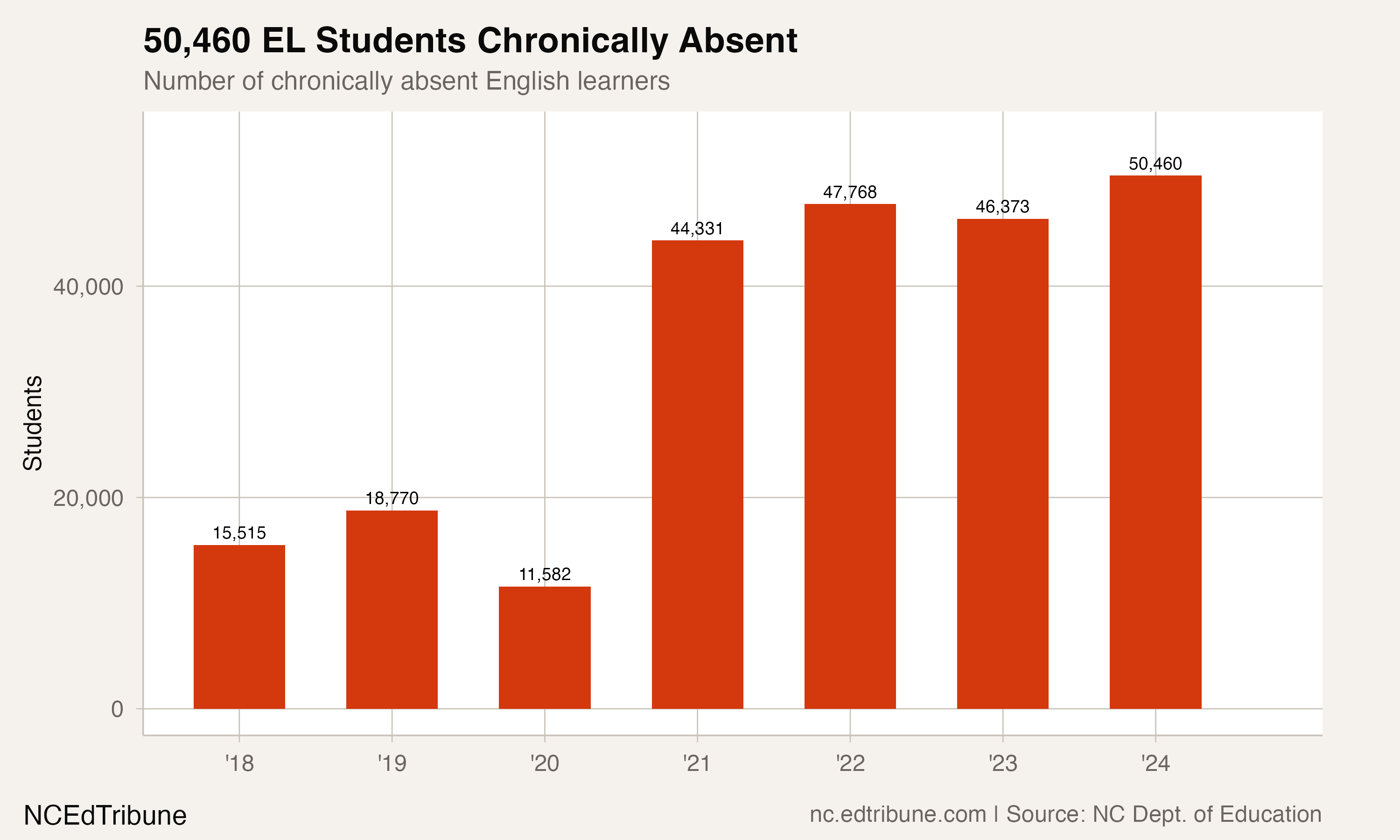
The absolute numbers underscore the scale: 50,460 English learners chronically absent in 2023-24, up from 15,515 in 2017-18. For students who are simultaneously learning English and mastering grade-level content, every missed day compounds. A student learning English who misses 18 days loses not just the content instruction but the immersion exposure that drives language acquisition. The cost of chronic absence for EL students is, by definition, higher than for students who already speak the language of instruction.
The EL reversal complicates the narrative that chronic absenteeism is simply a poverty or a race issue. English learners cut across racial lines: many are Hispanic, but significant numbers are Asian, African, and Middle Eastern. The subgroup's shift from below-average to above-average attendance suggests that COVID disrupted something specific to the immigrant and EL experience, not just the broader socioeconomic factors that drive absence for all students. Until the state's EL attendance returns to its pre-COVID advantage, the recovery will remain incomplete in a way that the aggregate numbers do not capture.
Detailed code that reproduces the analysis and figures in this article is available exclusively to EdTribune subscribers.
Discussion
Sign in to join the discussion.
Loading comments...