North Carolina spent more than a decade doing what most states only talk about. From 2006 to 2017, the state's four-year cohort graduation rate climbed from 68.3% to 86.5% — an 18.2 percentage point surge that transformed what had been a mediocre system into one that graduated more than six in seven students on time.
Then progress stopped.
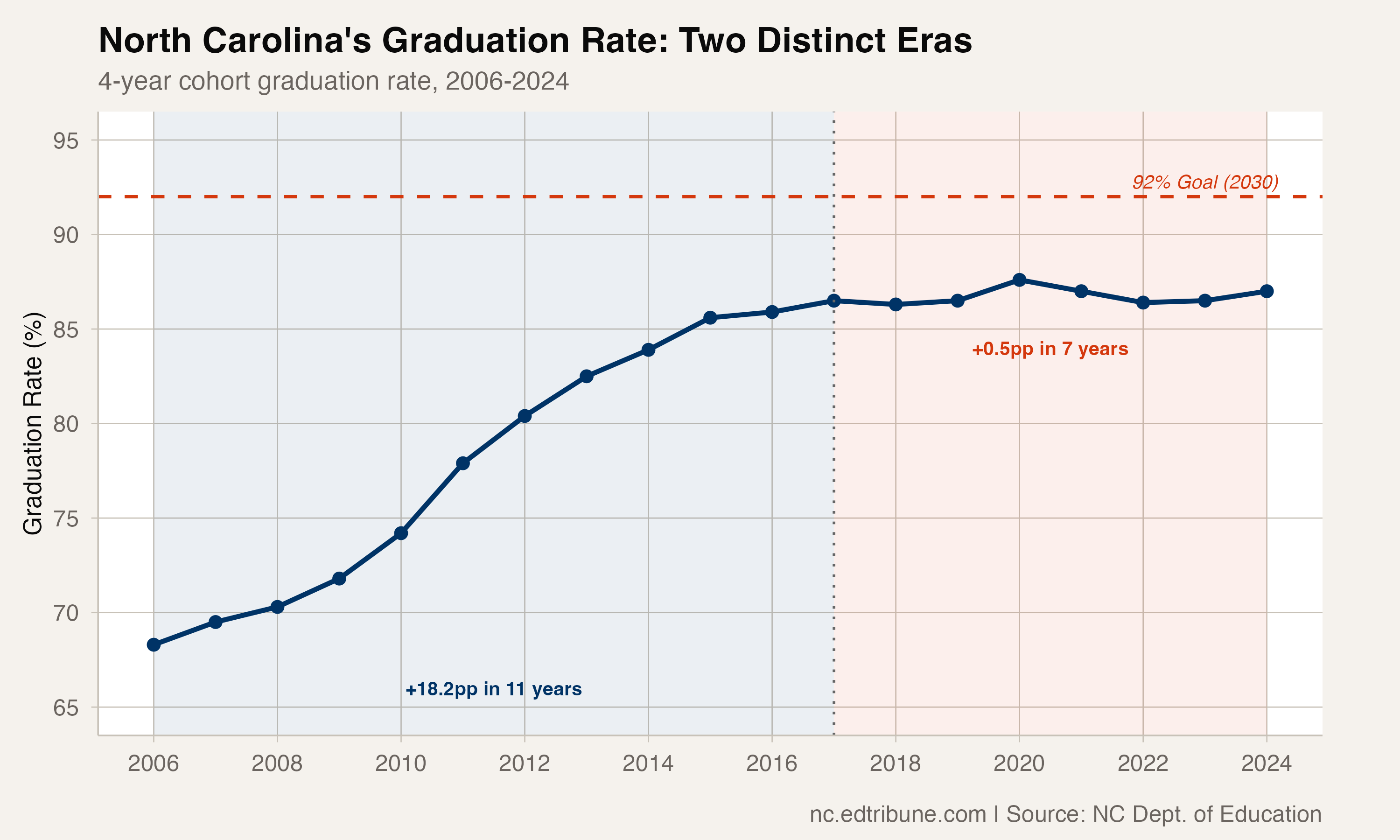
In the seven years since 2017, the rate has moved exactly 0.5 percentage points — from 86.5% to 87.0%. The annual gains that once averaged 1.7 points per year have effectively zeroed out. North Carolina's graduation rate has never crossed 90%.
The improvement era: what went right
The scale of the 2006-2017 improvement is difficult to overstate. In 2006, nearly one in three North Carolina students did not graduate on time. By 2017, fewer than one in seven failed to complete.
The gains came in a distinctive pattern. The fastest improvement happened during 2010-2013, when the rate jumped from 74.2% to 82.5% — an average of 2.8 points per year. These years coincided with the implementation of North Carolina's Future-Ready Course of Study, which established clearer graduation pathways and diploma endorsements.
The climb wasn't smooth. The rate dipped slightly in 2018, the first decline since the data series began. But the overall direction was unmistakable — and it moved North Carolina from the bottom half of states to the middle of the pack.
What the plateau looks like
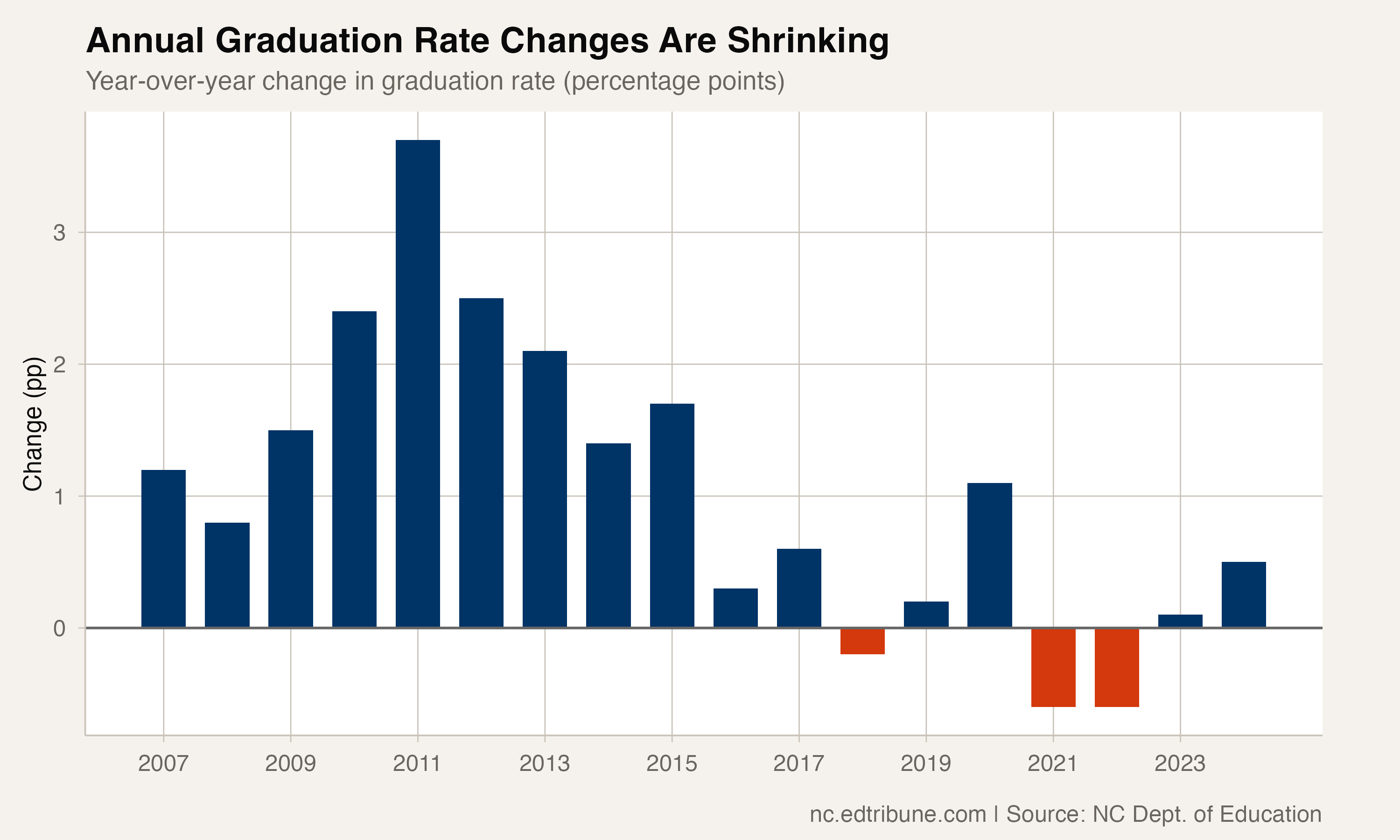
Since 2017, the graduation rate has oscillated in a narrow band between 86.3% and 87.6%. The year-over-year changes tell the story:
- 2018: -0.2 points
- 2019: +0.2 points
- 2020: +1.1 points (COVID-era high of 87.6%)
- 2021: -0.6 points
- 2022: -0.6 points
- 2023: +0.1 points
- 2024: +0.5 points
The COVID year stands out. The 2020 graduation rate of 87.6% remains the all-time high, suggesting that pandemic-era accommodations — relaxed attendance requirements, altered grading policies — may have temporarily inflated the number. The subsequent two-year decline and slow recovery reinforce that interpretation.
The 92% goal and the math that doesn't work
North Carolina has set a statewide target of 92% graduation by 2030, established through the MyFutureNC initiative. The gap between aspiration and trajectory could not be wider.
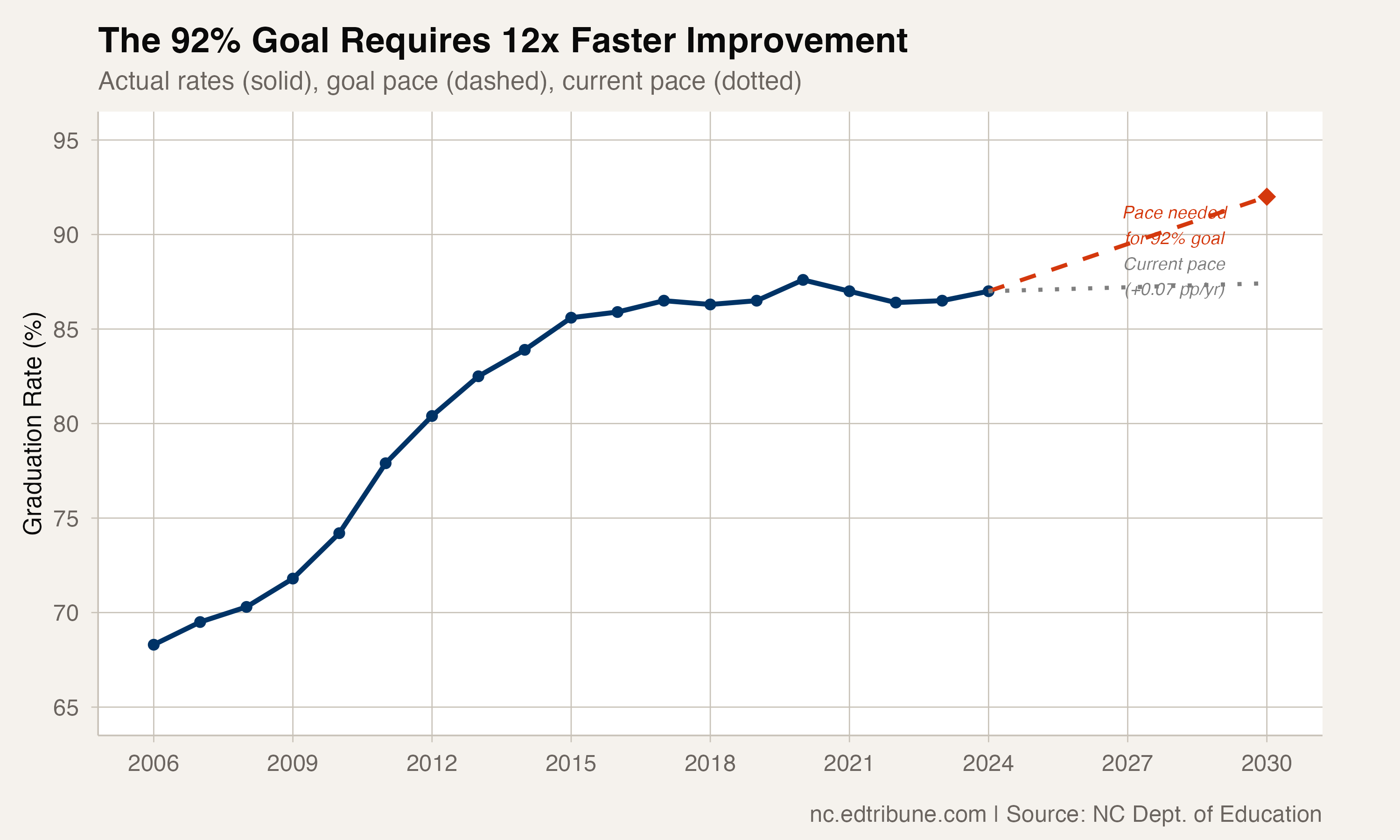
At the current seven-year pace of +0.07 percentage points per year, North Carolina would need more than 70 years to reach 92%. To hit the target by 2030, the state would need to gain 0.83 points annually — a pace it has not sustained since 2015.
The state's ESSA accountability target for 2023-24 was 90.5%. North Carolina posted 87.0%, missing by 3.5 points.
Where the remaining 13% are
Getting from 87% to 92% means reaching roughly 6,100 additional students each year. State data reveals who those students are: foster care youth graduating at 55.4%, students who are currently homeless at 69.7%, special education students at 71.6%, and English learners at 73.0%.
The easy gains — systemic improvements that lift the middle of the distribution — have already been captured. The students who remain below the graduation line are disproportionately those facing the most complex barriers: poverty, housing instability, disability, and language. Moving them across the finish line requires fundamentally different interventions than the broad reforms that powered the 2006-2017 improvement.
What breaking through would require
Attendance is the most commonly cited barrier. About 40% of all dropouts leave school primarily due to attendance issues, making it the single largest factor. North Carolina's post-COVID chronic absenteeism crisis has compounded this, with about 24% of students chronically absent in recent years.
The diploma pathway itself may also be a barrier for some students. About 19% of students with Individualized Education Programs exit special education by dropping out, suggesting the 22-credit Future-Ready Course of Study does not accommodate every learner.
No state has sustained the kind of improvement North Carolina achieved from 2006-2017 across two decades. The plateau may simply be what happens when a system exhausts the structural reforms available to it. Whether North Carolina can find a second act — or whether 87% represents something close to a ceiling — will define the next era of the state's education story.
Detailed code that reproduces the analysis and figures in this article is available exclusively to EdTribune subscribers.
Discussion
Sign in to join the discussion.
Loading comments...