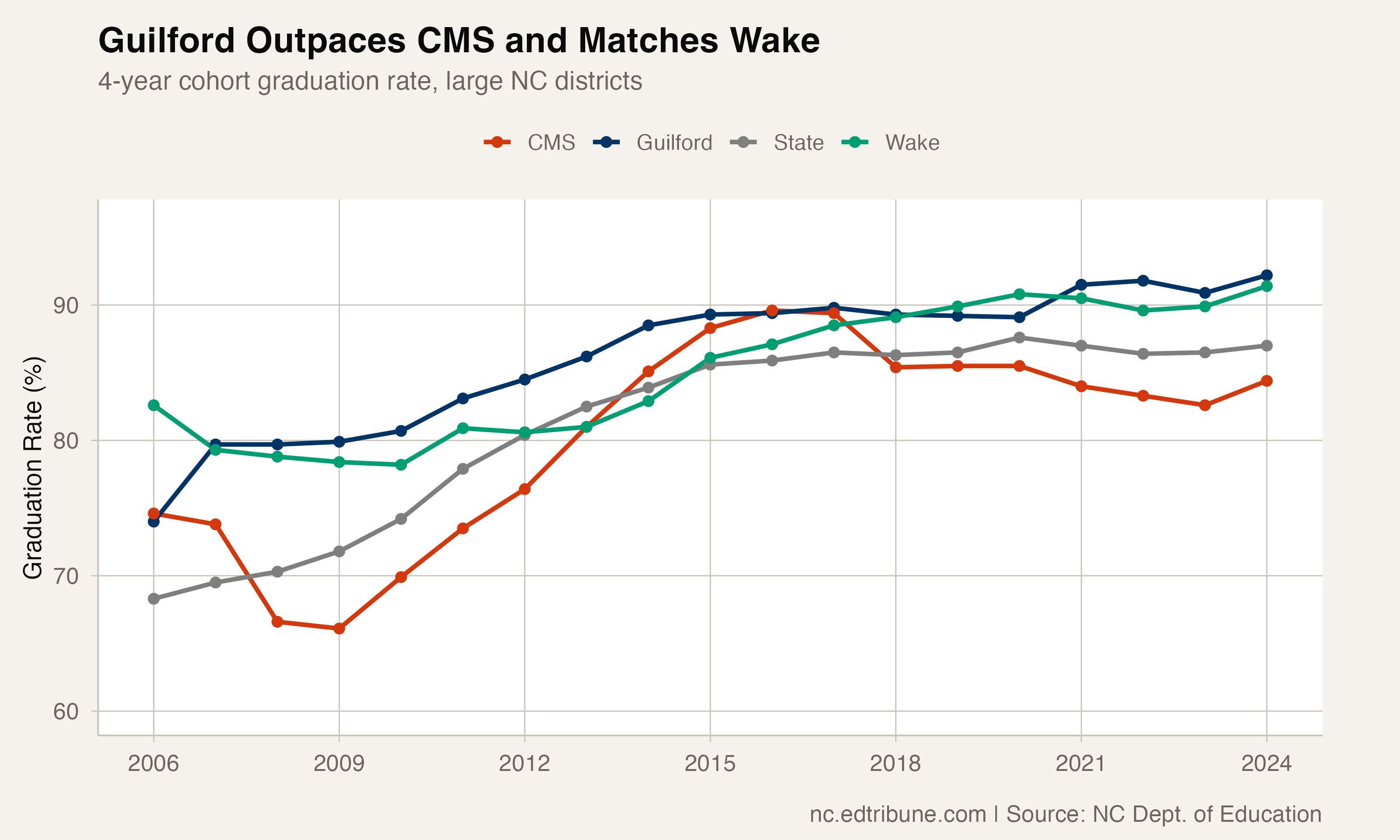
Guilford County Schools↗ET has done something no other large district in North Carolina has managed: sustained excellence without interruption. The state's third-largest district posted a 92.2% graduation rate in 2024 — an all-time high — capping eight consecutive years at or above 89%.
That 92.2% tops Wake County↗ET at 91.4% and leaves Charlotte-Mecklenburg↗ET at 84.4% in the rearview mirror.
The transformation
In 2006, Guilford graduated 74.0% of its students — roughly in line with the state average of 68.3%. The district's 18.2 percentage point improvement mirrors the state's overall gain almost exactly. But where the state plateaued in 2017, Guilford kept climbing.
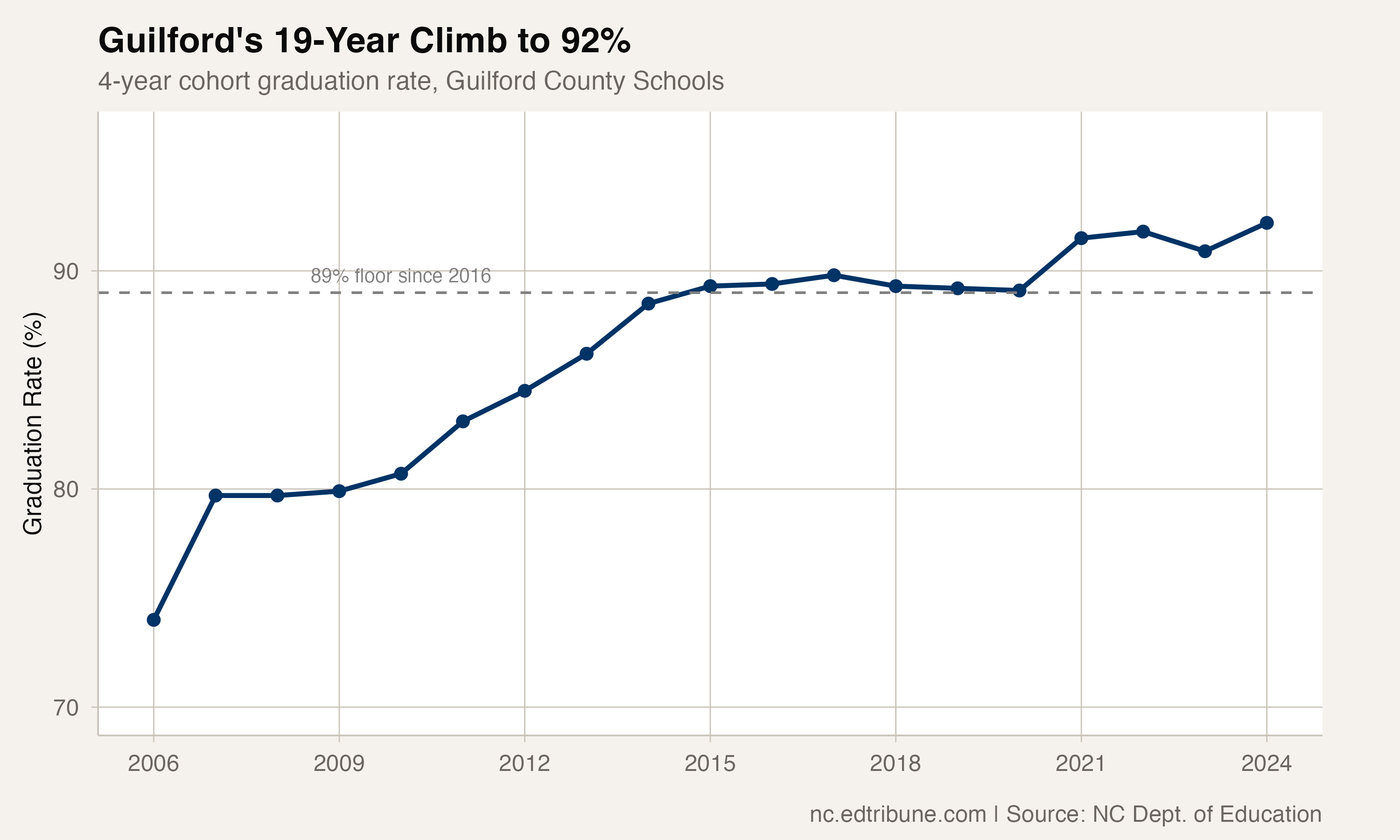
The consistency sets Guilford apart. Since 2016, the district has not posted a rate below 89%. It has been above 91% for three consecutive years. With 5,553 students in its 2024 cohort, this is not a small district riding statistical volatility — it is a large, diverse system delivering sustained results.
Lifting every group
The most important evidence that Guilford's improvement is genuine comes from the racial breakdown. The district serves a student body that is roughly 40% Black, 20% Hispanic, and 28% white — demographics similar to Charlotte-Mecklenburg.
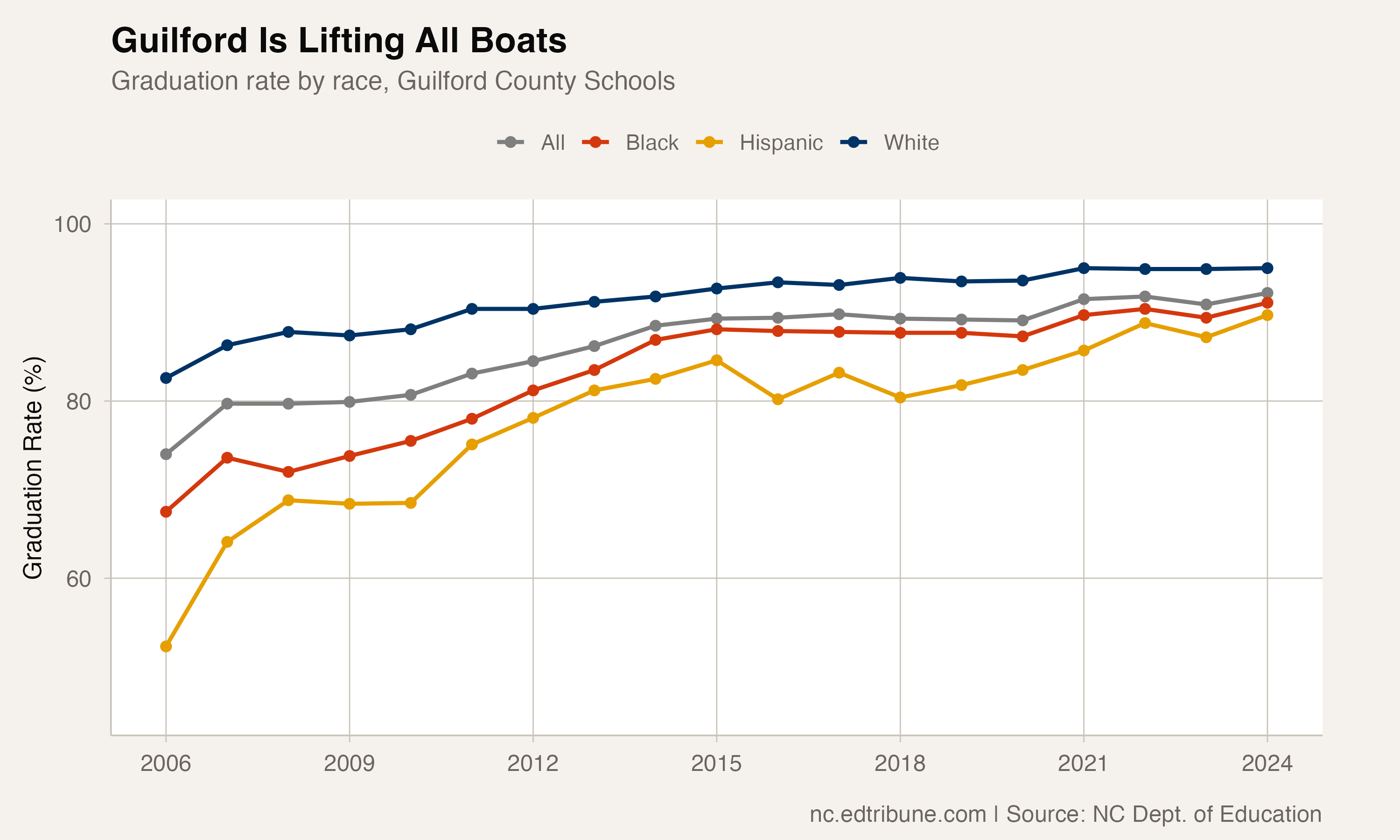
All racial groups have improved significantly since 2006. Guilford's Black graduation rate, while still lower than white, has risen steadily and remains above the state average for Black students. The pattern suggests district-wide institutional change, not improvement driven by one demographic segment.
The large-district comparison
Among North Carolina's ten largest districts by graduation cohort, Guilford's 92.2% rate is the highest. The top five:
- Guilford County Schools: 92.2% (5,553 cohort)
- Wake County Schools: 91.4% (13,435 cohort)
- Forsyth County Schools: 89.2% (4,301 cohort)
- Cumberland County Schools: 87.2% (4,662 cohort)
- Charlotte-Mecklenburg Schools: 84.4% (11,571 cohort)
Guilford's ability to outperform Wake — a district with twice the cohort size and a more affluent tax base — is the strongest signal that the district's results reflect something intentional.
What Guilford is doing
Guilford County has invested in graduation coaching programs and early warning systems that flag students at risk of not completing. The district's dual enrollment partnerships with regional community colleges provide alternative pathways for students who may not thrive in the traditional four-year course sequence.
Whether those specific interventions drove the results or whether Guilford benefits from a more distributed poverty profile than Charlotte-Mecklenburg is difficult to disentangle from the data. What the numbers show clearly is that a large, diverse, urban-suburban district in North Carolina can sustain graduation rates above 90%.
Detailed code that reproduces the analysis and figures in this article is available exclusively to EdTribune subscribers.
Discussion
Sign in to join the discussion.
Loading comments...