Correction (2026-05-02): An earlier version misstated the gap between students in foster care and students who are currently homeless as 13.4 percentage points (the correct figure is 14.3) and described foster care students as more than five times as likely as the average student to miss on-time graduation (the correct ratio is roughly 3.4 times). The description of year-over-year changes has also been clarified.
In 2018, the first year North Carolina reported graduation rates for students in foster care, 73.4% graduated on time. That was already 12.9 percentage points behind the state average of 86.3%, but it was within a range that policy intervention might close.
Six years later, the gap has more than doubled and the rate has not recovered.
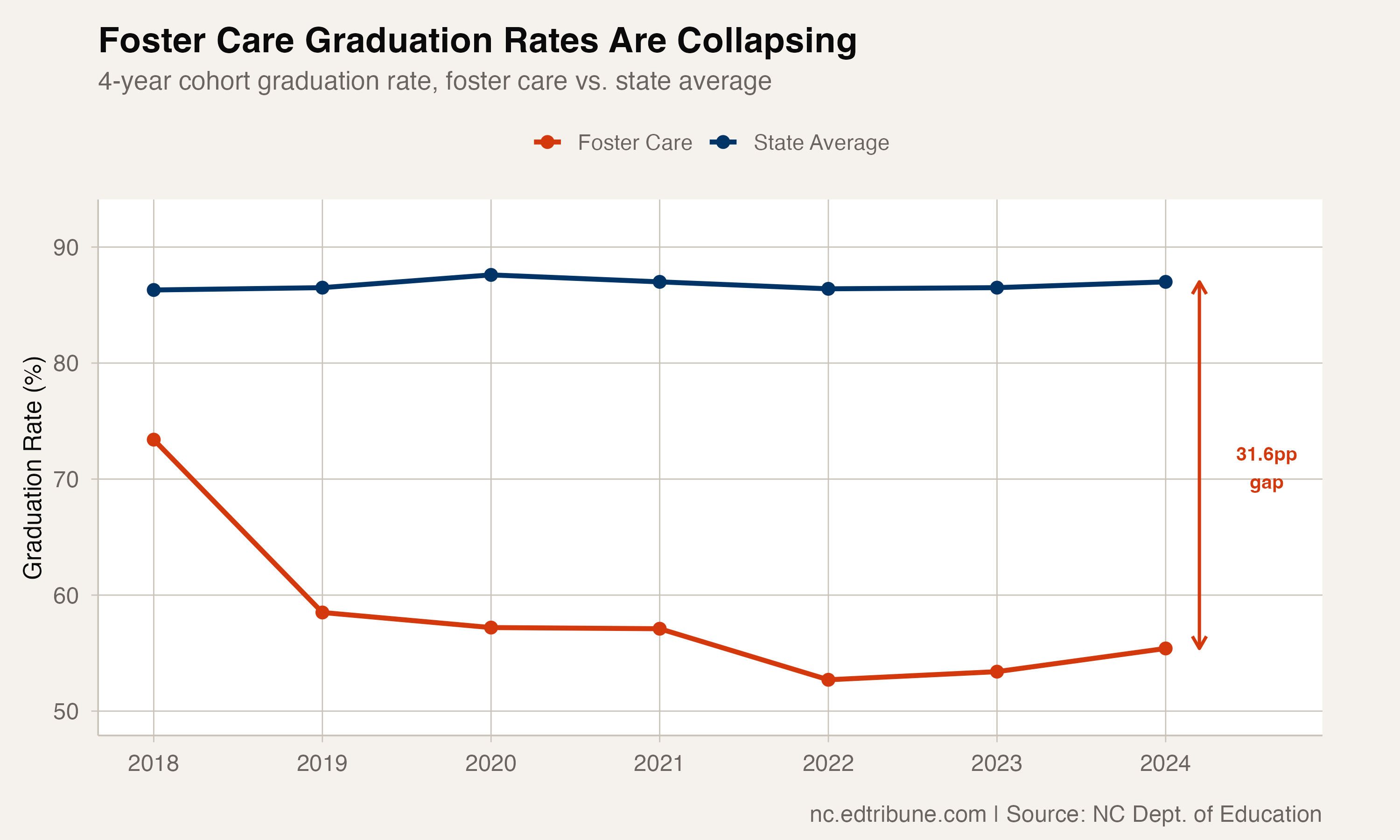
The graduation rate for students in foster care fell to 55.4% in 2024, an 18.0 percentage point drop from 2018. Over the same period, the state's overall rate edged up from 86.3% to 87.0%. About 345 of the 774 students in foster care in the 2024 cohort did not graduate on time.
The most recent two years show small improvements — 53.4% in 2023 and 55.4% in 2024, up from a low of 52.7% in 2022 — but the rate remains far below where it started.
A gap that has more than doubled
The gap between students in foster care and the state average widened from 12.9 percentage points in 2018 to 31.6 points in 2024. No other subgroup in North Carolina's graduation data shows a disparity of comparable size.
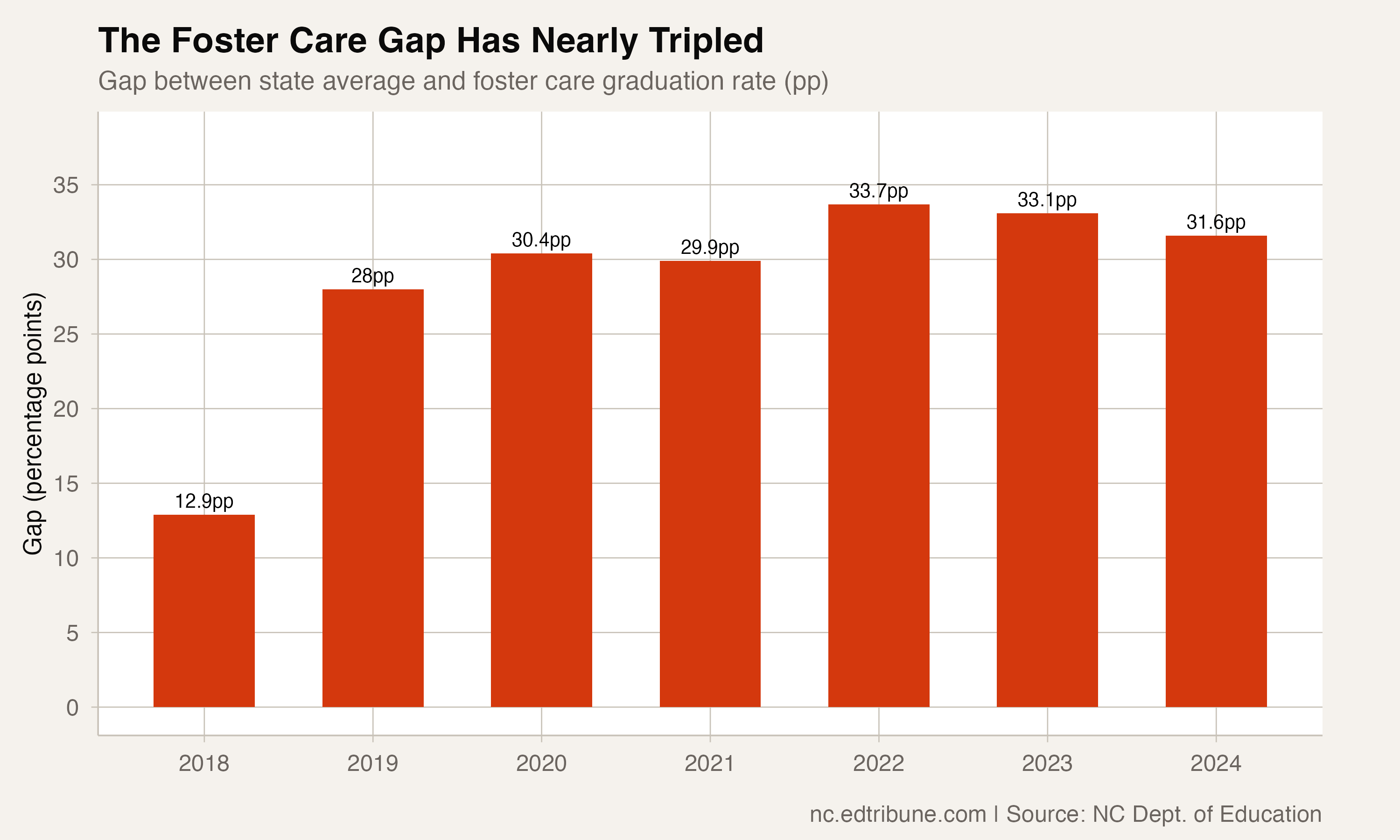
A 31.6-point gap means a student in foster care in North Carolina is roughly 3.4 times as likely as the average student to miss on-time graduation (44.6% versus 13.0%). Put another way: if students in foster care graduated at the state rate, about 245 additional students would receive a diploma each year.
Small subgroup, structural pattern
With 774 students in the 2024 cohort, foster care is a small subgroup relative to the state's 122,510 total graduates. It is not, however, small enough that statistical noise explains the trend. Across the seven reported years, the rate fell sharply in four year-over-year transitions (notably a 14.9 point drop from 2018 to 2019), held roughly flat in another, and ticked up in 2023 and 2024.
The shape of the trend — a steep early drop followed by a sustained low plateau — points to structural factors rather than year-to-year noise.
The widest gap among vulnerable subgroups
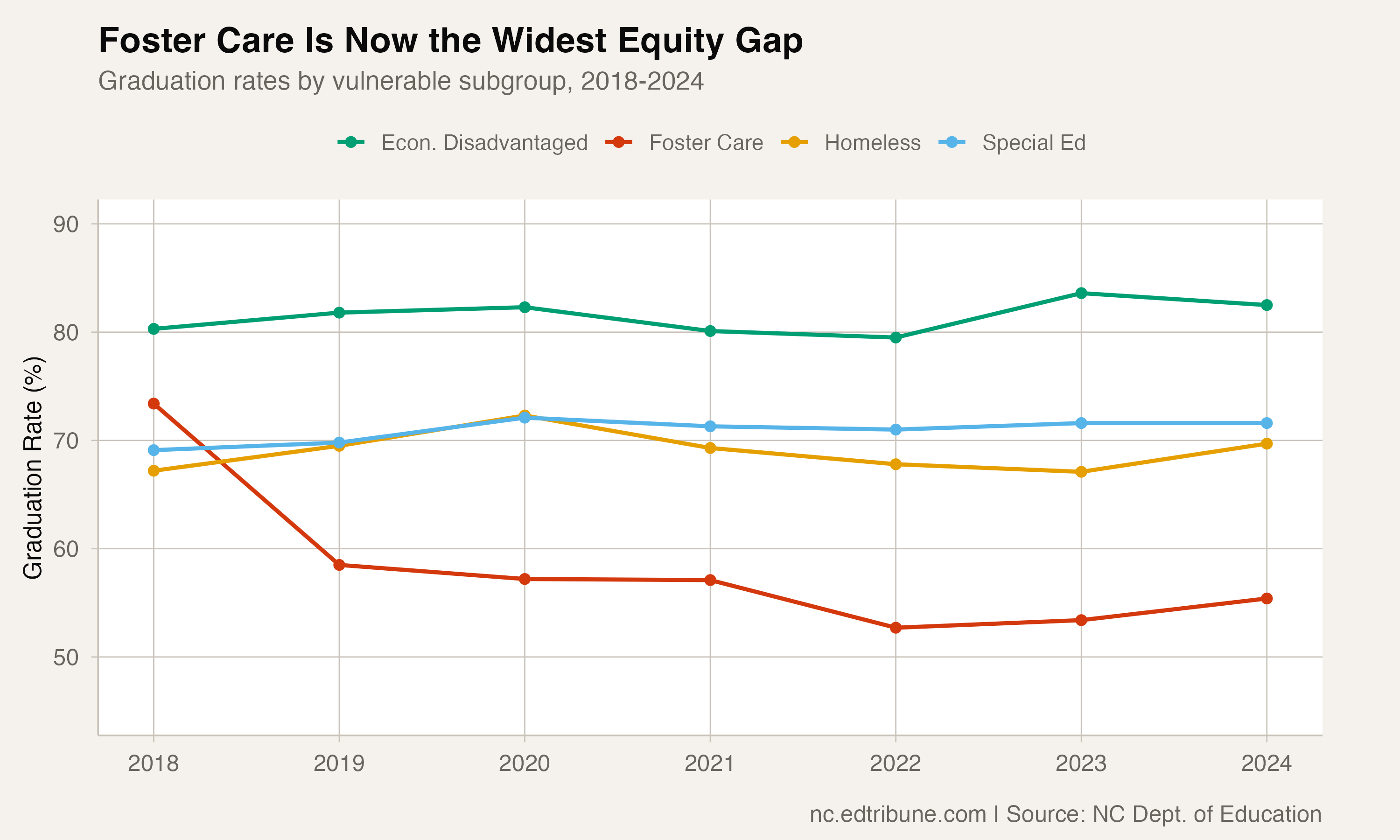
North Carolina reports graduation rates across multiple subgroups. In 2024, students in foster care graduated at lower rates than every other group the state breaks out:
- Students in foster care: 55.4%
- Students who are currently homeless: 69.7%
- Students receiving special education: 71.6%
- Students who are English learners: 73.0%
- Students who are economically disadvantaged: 82.5%
The 14.3 percentage point gap between students in foster care and the next-lowest group is itself wider than most equity gaps that appear in the state's reporting.
Why students in foster care fall behind
Students in foster care face a set of compounding barriers that the standard graduation pathway was not designed to accommodate. Placement instability often means frequent school changes, with each move requiring credit transfer, relationship rebuilding, and navigating a new system. Research on student mobility consistently finds that even one mid-year school change during high school is associated with measurable academic setbacks.
North Carolina's Guardian ad Litem program provides court-appointed advocates for children in the child welfare system, and the state's educational stability provisions are intended to maintain school continuity during placement changes. The persistence of the gap suggests these guardrails are not sufficient given the scale of disruption many of these students experience.
The 22-credit Future-Ready Course of Study assumes a level of continuity that students in foster care often do not have. Credit recovery programs, alternative pathways, and fifth-year options exist, but availability and access vary across districts.
A small population, a large gap
The foster care subgroup gets less attention in North Carolina's education policy debates than racial equity gaps, district performance, or the statewide graduation plateau. With 774 students entering the cohort each year, it is easy to overlook in aggregate statistics.
But 55.4% is a rate that would prompt intervention if it appeared at the school or district level. Applied to one of the most vulnerable populations the state tracks, it represents a sustained gap in the promise that every child has a path to a diploma.
Detailed code that reproduces the analysis and figures in this article is available exclusively to EdTribune subscribers.
Discussion
Sign in to join the discussion.
Loading comments...