North Carolina's statewide 4-year graduation rate was 87.0% in 2024. That looks like a plateau: from 2017 through 2024, the state figure stayed between 86.3% and 87.6%, a 1.3-point band.
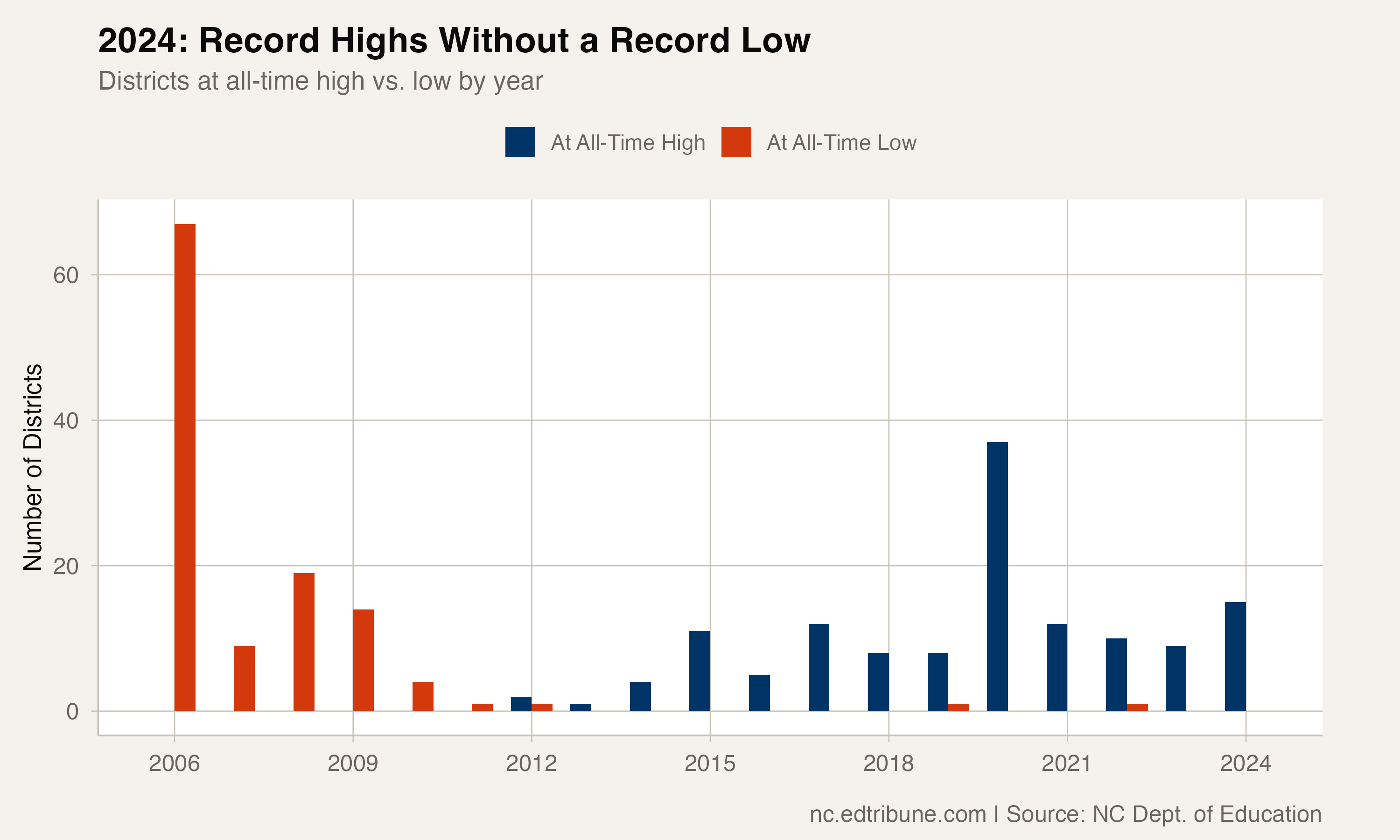
Under that flat state line, 15 districts reached all-time highs in the full 2006-2024 graduation series. No district with at least three years of data hit an all-time low in 2024.
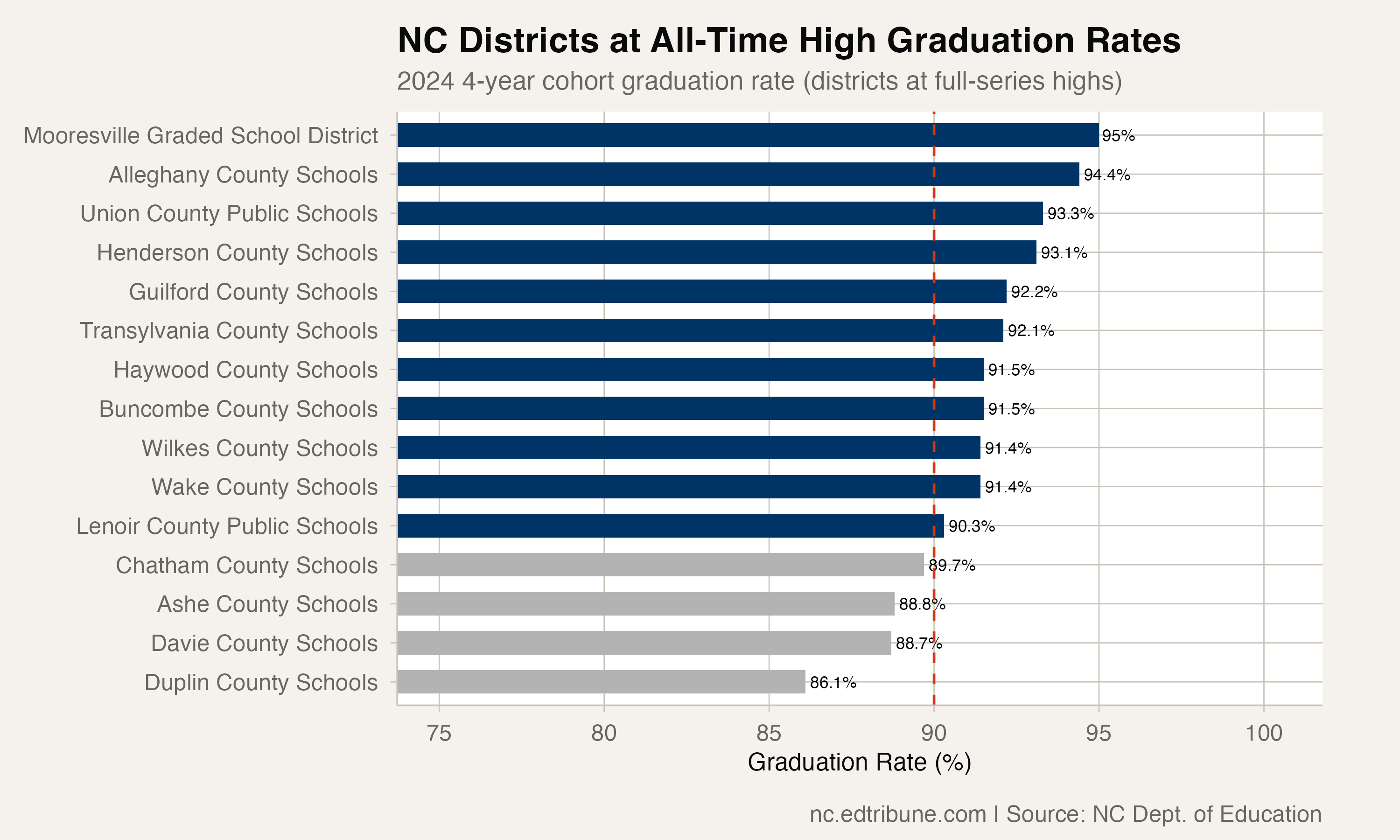
Eleven of the 15 all-time-high districts were at or above 90%. The highest rates in that group belonged to Mooresville Graded↗ET at 95.0%, Alleghany County↗ET at 94.4%, Union County↗ET at 93.3%, Henderson County↗ET at 93.1%, Guilford County↗ET at 92.2%, and Transylvania County↗ET at 92.1%.
This was not only a small-district story. Wake County↗ET reached an all-time high of 91.4% with a 13,435-student cohort, and Guilford County reached 92.2% with a 5,553-student cohort.
The records and the ties
Thirteen of the 15 all-time-high districts set new highs rather than matching an earlier peak. Mooresville, at 95.0%, and Duplin County↗ET, at 86.1%, tied earlier highs in the package data instead of surpassing them.
That distinction matters. Dare County↗ET had a higher 2024 rate than most districts on the chart, at 94.5%, but it was not on the all-time-high list because its full-series peak was 95.0% in 2016.
Crossing 90% for the first time
Two districts crossed 90% for the first time in 2024: Transylvania County↗ET, at 92.1%, and Lenoir County↗ET, at 90.3%.
Lenoir County's milestone is the steeper climb. The district was at 55.5% in 2006 and reached 90.3% in 2024. Transylvania County's previous full-series high was 89.0% in 2022 before its 92.1% mark in 2024.
Why the state average can stay flat
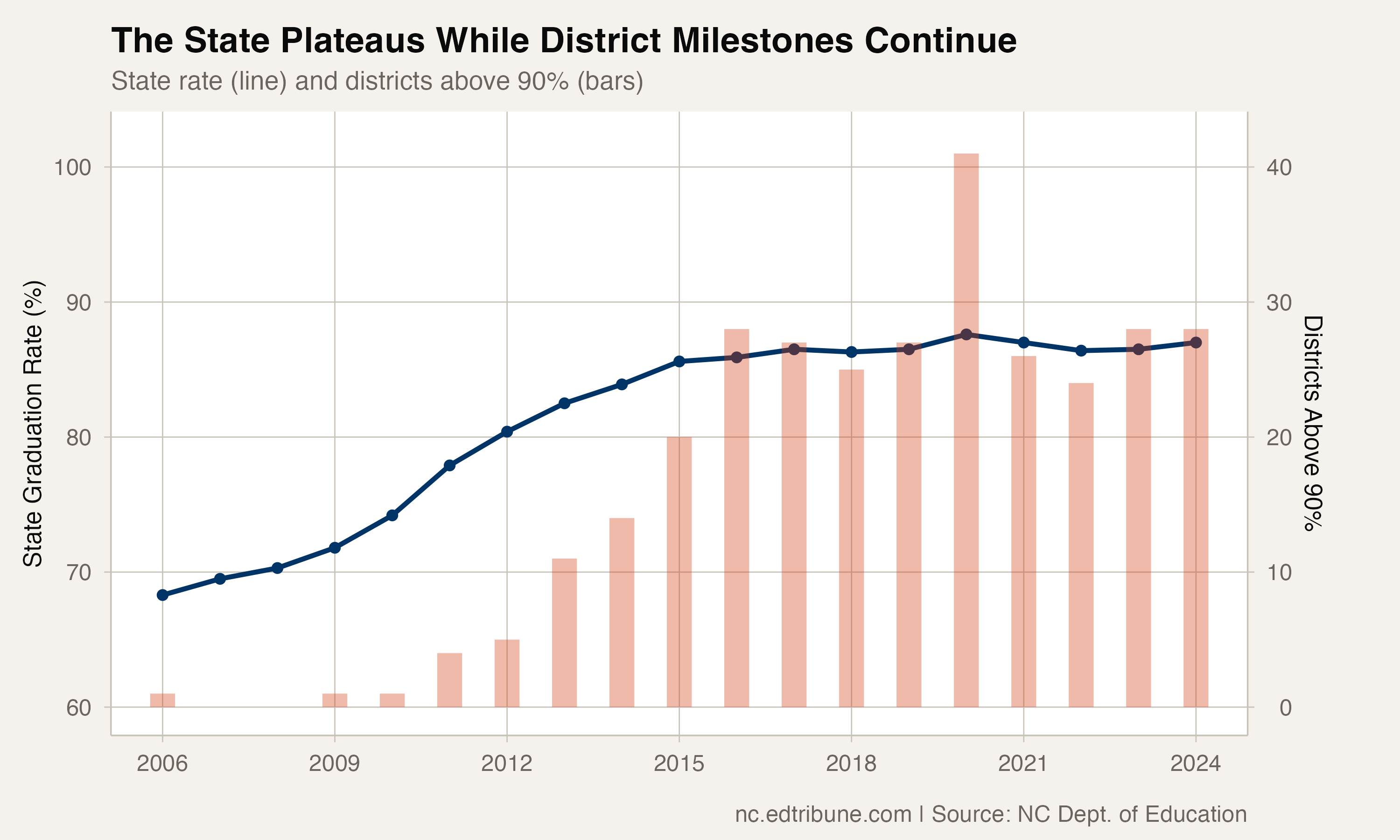
The arithmetic explanation is direct evidence: statewide graduation rates are shaped by cohort size, so large districts below the state rate can offset several smaller districts setting highs.
Charlotte-Mecklenburg Schools shows the pressure point. Its 2024 graduation rate was 84.4%, below its 2016 peak of 89.6%, and its 2024 cohort had 11,571 students. A district that large can weigh heavily on the statewide rate even when many smaller systems are setting records.
The 2024 picture is therefore mixed rather than simply celebratory. North Carolina's statewide rate was still sitting near 87.0%. But below that plateau, 15 districts reached full-series highs, 11 of them cleared 90%, and none hit a full-series low.
Detailed code that reproduces the analysis and figures in this article is available exclusively to EdTribune subscribers.
Discussion
Sign in to join the discussion.
Loading comments...