Correction (June 4, 2026): District-level enrollment and chronic absence counts in this article were corrected after a data processing error was identified. The peer comparison was also re-tuned to reflect Gaston's corrected enrollment.
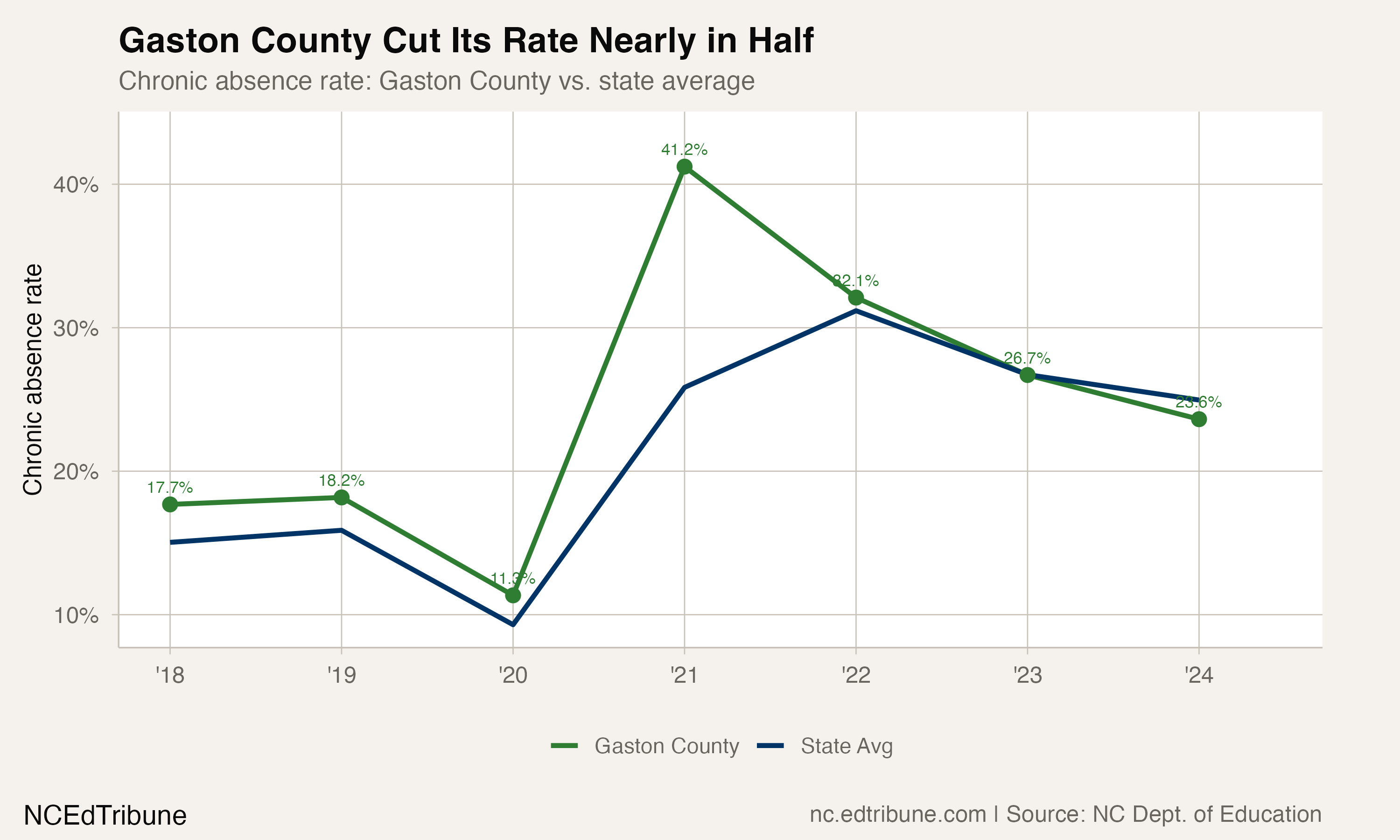
Gaston County Schools↗ET recorded the highest chronic absence rate among North Carolina's 10 largest districts in 2020-21: 41.2%. Three years later, Gaston's rate was 23.6%, a 17.6-point decline from its peak.
Chronic absenteeism is commonly defined as missing at least 10% of school days, or roughly 18 days in a full school year, according to federal chronic-absence guidance.
The trajectory has been consistent: 41.2% to 32.1% to 26.7% to 23.6%, improving every single year without a plateau. The 31,972-student district is now near the state average of 25.0%, having moved below it in the latest 2023-24 data.
Three consecutive years of improvement
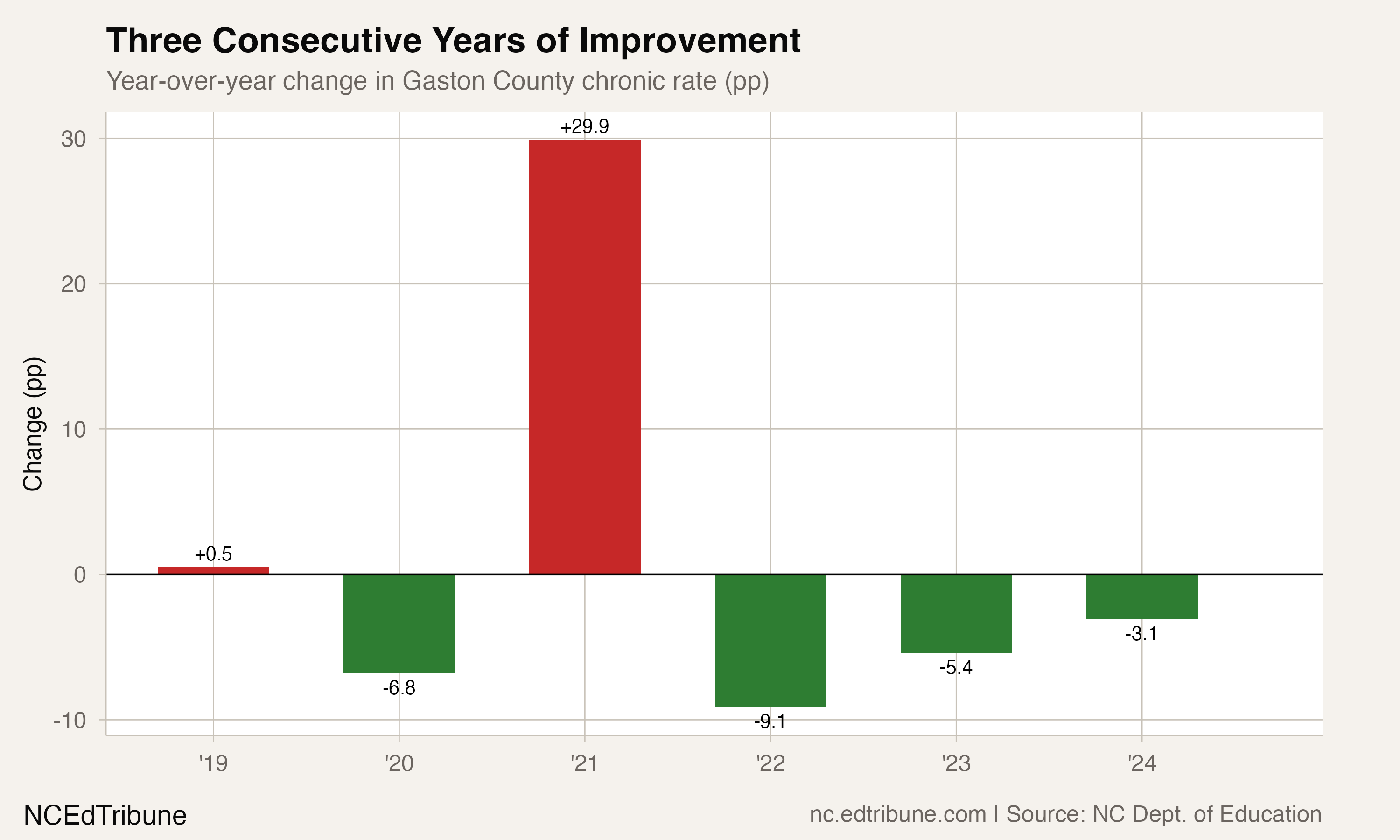
Each year's improvement has been substantial: 9.1 points in the first year, 5.4 in the second, 3.1 in the third. The annual gains got smaller as the rate fell, but the data are direct evidence that Gaston moved steadily downward for three consecutive reporting years.
The recovery has taken Gaston from highest-rate among top-10 districts to roughly average. Before COVID, its 18.2% chronic rate was slightly above the state's 15.9%. It is now at 23.6% versus the state's 25.0%, below the state mark in the latest data. The reversal followed a 23.1-point 2019-to-2021 increase, the eighth-steepest spike among North Carolina districts with data in both years.
Among peers, the best recovery
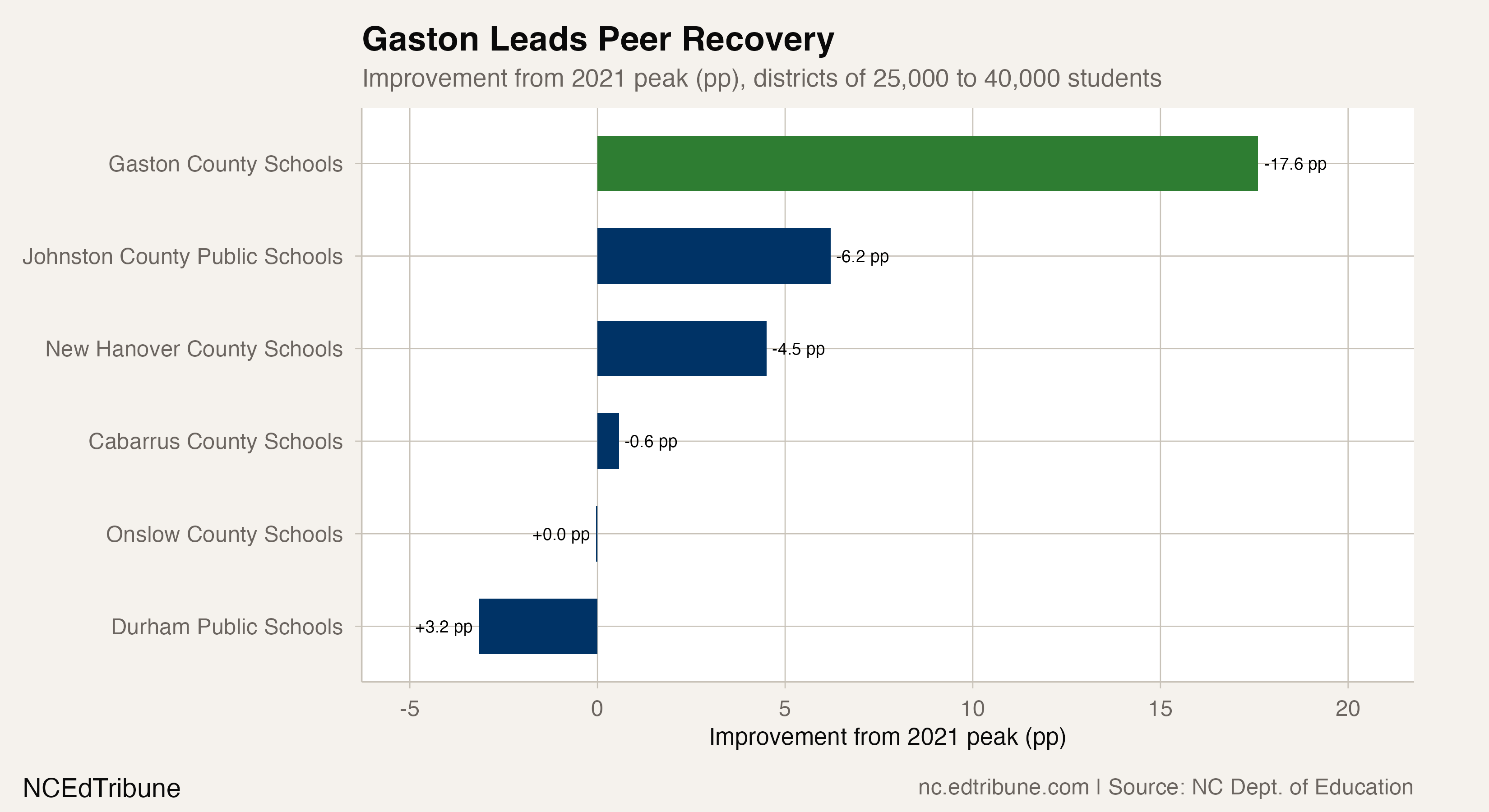
Among districts with 25,000 to 40,000 students in 2024, Gaston County's improvement from its 2021 peak exceeds every peer. The 17.6-point drop from 41.2% to 23.6% is substantially larger than Johnston County's 6.2-point improvement or New Hanover County's 4.5-point improvement over the same period. The comparison covers six districts in this size range, so it is a peer-band result rather than a statewide rank.
The remaining gap between Gaston's 23.6% and its pre-COVID 18.2% is 5.5 points, representing approximately 1,700 students who are chronically absent now but were not before the pandemic. Whether closing that final gap takes the same work that produced the first 17.6 points is a question the state attendance files cannot answer.
What the district credits
The state files measure the decline. They do not say what produced it. Asked that question directly, Todd Hagans, Chief Communications Officer for Gaston County Schools, answered in writing on September 17 and named four efforts the district believes contributed.
The most visible was a districtwide attendance campaign, branded "Attendance Matters!" and aimed at employees as well as students. In a written response to The NCEdTribune, Hagans described district-level messaging, social media posts, website articles and announcements, district-produced videos, and a video contest among schools, and quoted the premise the campaign put in front of both audiences at once: "Teachers have to be at school to teach for students to learn, and students have to be at school for teachers to have someone to teach."
Behind the campaign was casework. School social workers and student support staff identified students who were chronically absent and contacted their families. That outreach went past restating the importance of attendance and into the circumstances keeping students home. Hagans told The NCEdTribune that staff worked to address "transportation issues, health and wellness concerns, and family living conditions."
A third effort targeted students identified as at risk of dropping out and not graduating. The district put academic services and student support services staff on a program that works with those students on the courses and credits they still need, offering flexible scheduling and, in Hagans's description, frequent supervision and support so the students finish the requirements.
The fourth is the one furthest from attendance on its face. Gaston restructured its approach to teaching and learning in 10 schools it describes as consistently low-performing, introducing an Innovation Schools model with Advanced Teacher Roles, instructional coaching, data-driven analysis and decision-making, and more teacher and staff collaboration in Professional Learning Communities. Hagans connects that to attendance through the energy it generated, writing that raising the profile of academic achievement produced excitement among students, teachers and staff about being at school. In written answers to The NCEdTribune he reported that the district saw "significant increases in student proficiency and academic growth" comparing 2025-2026 to previous school years. That result is the district's own, from the district's records. It is not in the state files this article analyzes, and it covers a school year the state has not yet published.
What the evidence can and cannot settle
The two halves of this story rest on different evidence, and the difference matters. The 17.6-point decline is measured: it sits in North Carolina's own attendance files, one reporting year at a time, and any reader can check it. The explanation is Gaston County Schools' account of its own work. Nothing in the state data can show that these four efforts caused the drop rather than ran alongside it, and the district does not claim otherwise, offering them as the factors it believes contributed.
In a state where Durham County was at 37.2% and Forsyth County was at 32.1% in 2024, Gaston County went from 41.2% to 23.6% in three reporting years. That is a sharp local recovery, and Gaston County Schools has now put its own account of how it happened on the record. What a neighboring district would have to find out is whether the same four efforts travel.
Detailed code that reproduces the analysis and figures in this article is available exclusively to EdTribune subscribers.
Discussion
Sign in to join the discussion.
Loading comments...