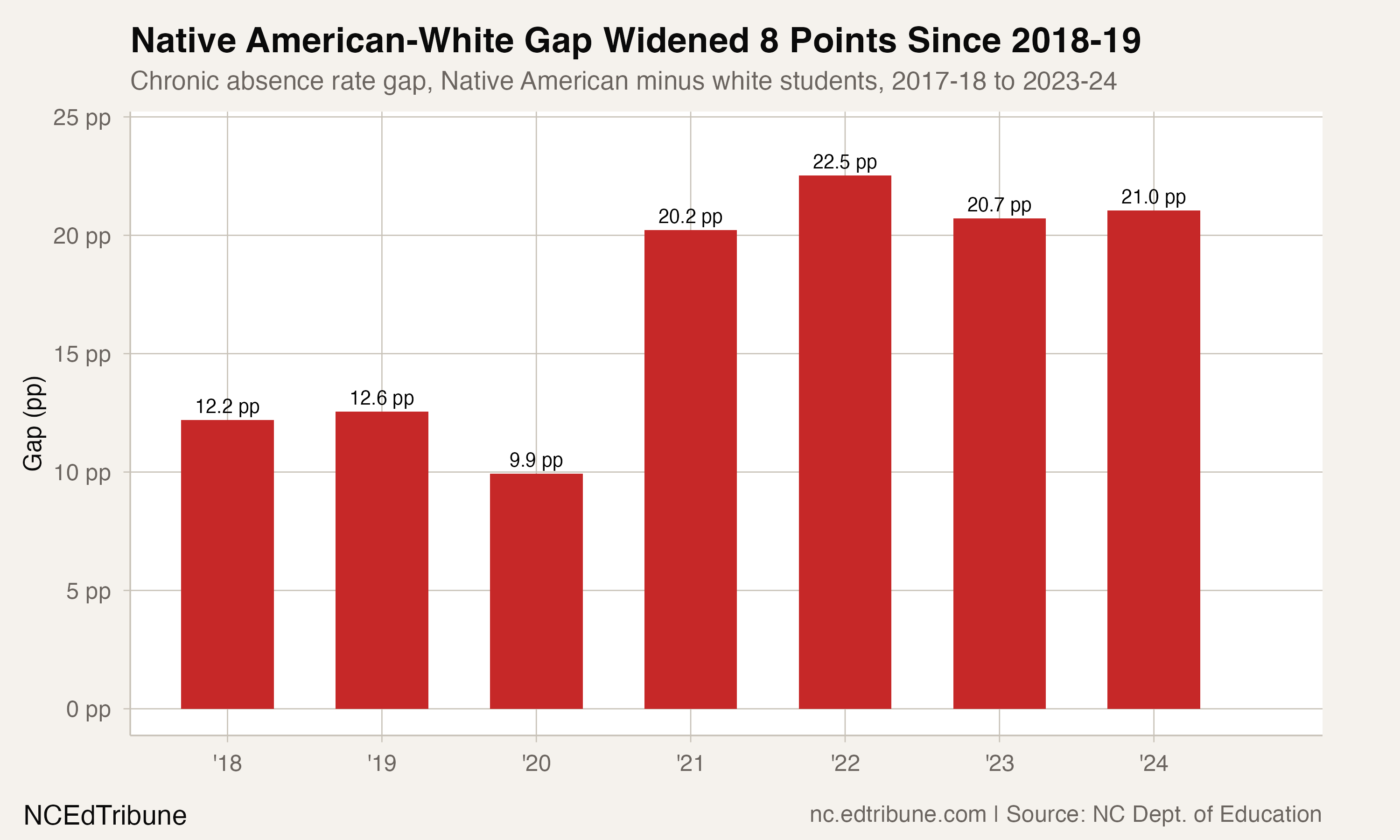
Native American students in North Carolina brought their chronic absence rate down from 48.7% in 2021-22 to 40.9% in 2023-24, the latest year of state attendance data available for this analysis. White students improved over the same two years, from 26.1% to 19.9%, so the distance between the two groups hardly moved: 22.5 percentage points at the 2021-22 peak, 21.0 points in 2023-24. Before COVID, in 2018-19, it was 12.6 points.
That 21-point gap is the widest of any racial group's gap with white students in the state's attendance data, and much of it runs through one district. The Public Schools of Robeson County↗ET, in the Lumbee Tribe's home territory, count about 7,800 Native American students in their chronic-absence cohort. That is about half of the roughly 15,400 statewide. In 2023-24, about 3,700 of them were chronically absent, 59% of all Native American students in North Carolina who were chronically absent that year.
A gap that was already wide before the pandemic
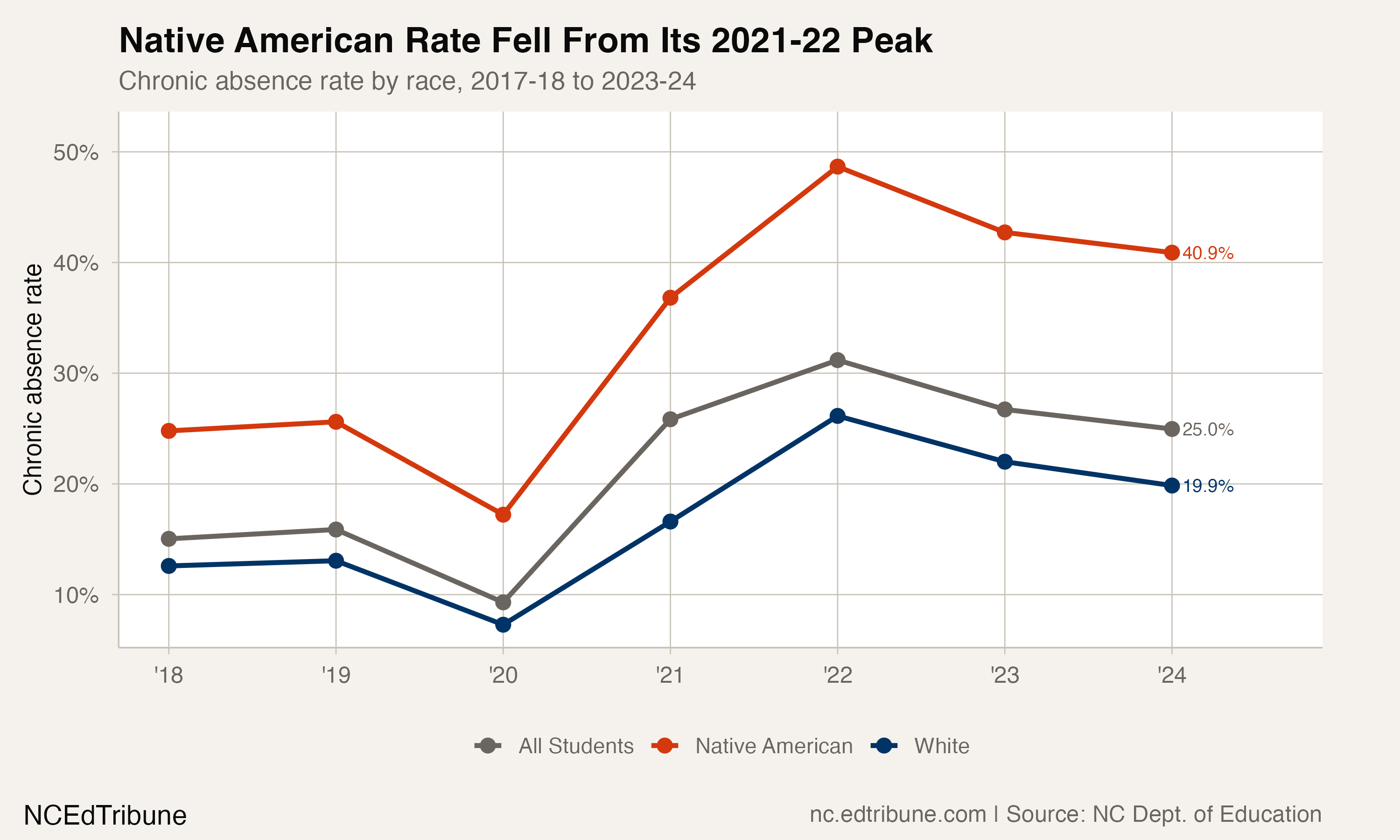
For Native American students, the attendance gap was already substantial before the pandemic. In 2018-19, 25.6% of Native American students were chronically absent, compared with 13.1% of white students. The published gap grew from 12.6 points to 21 points, and stayed above 20 points in every year from 2020-21 through 2023-24. The reported rates do not establish what caused that change.
In relative terms, a Native American student in 2023-24 was 2.1 times as likely to be chronically absent as a white student, close to the 2.0 ratio of 2018-19. Both groups' reported rates rose and then fell. Their similar relative ratios coexist with a larger gap in percentage points.
Every racial group is above pre-COVID, but not equally
The 2023-24 data shows a clear order. Native American students had the highest rate, 40.9%, followed by Black students at 31.5%, Pacific Islander students at 29.2%, multiracial students at 29.1% and Hispanic students at 28.4%. White students were at 19.9% and Asian students at 11.3%, the lowest rate of any racial group.
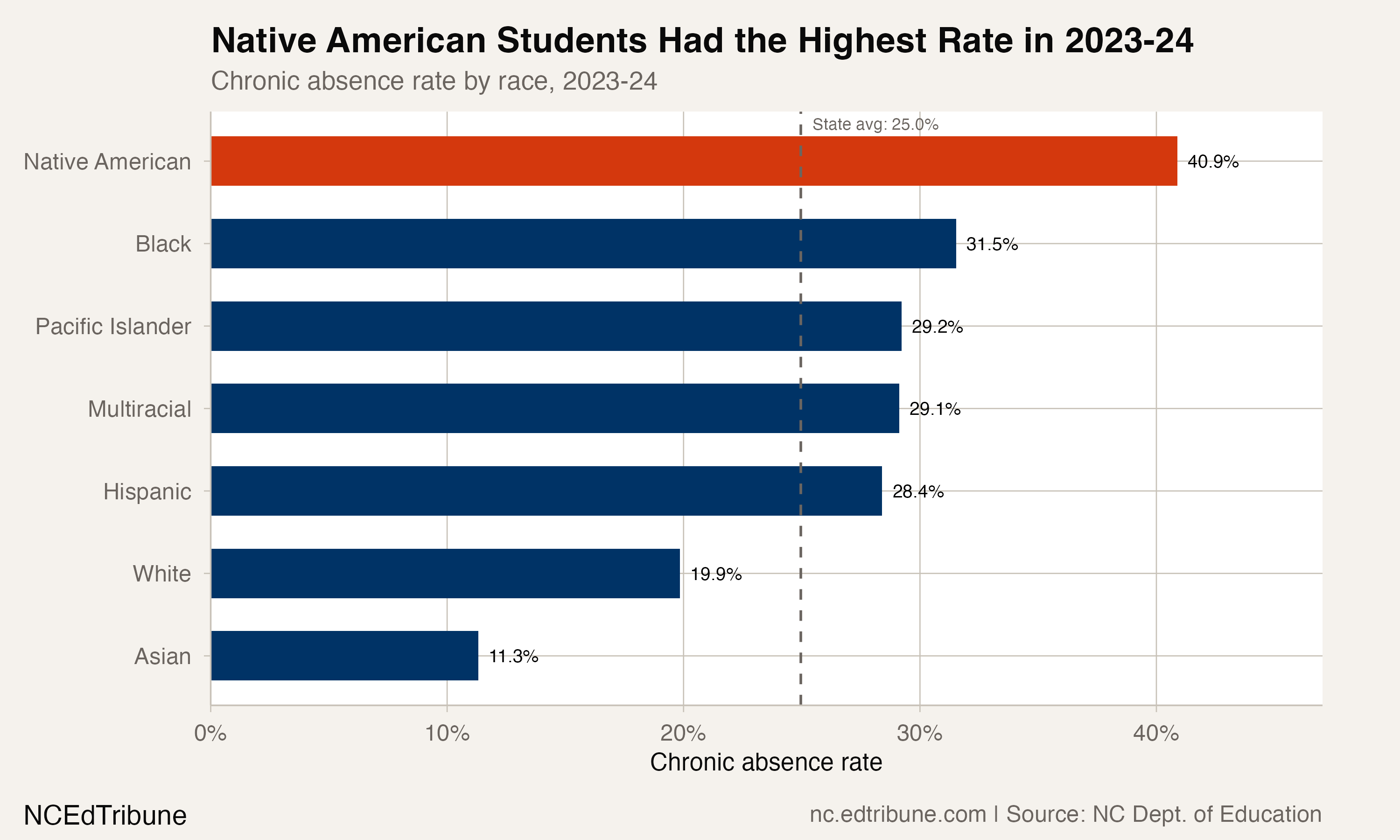
Every racial group had a higher chronic absence rate than before COVID. The increases were not proportional. Native American students added 15.3 percentage points to their 2018-19 rate. Hispanic students added 12.1 and Black students 11.8. White students added 6.8. The group that started with the highest rate also took the largest increase.
Robeson and the rest of the state
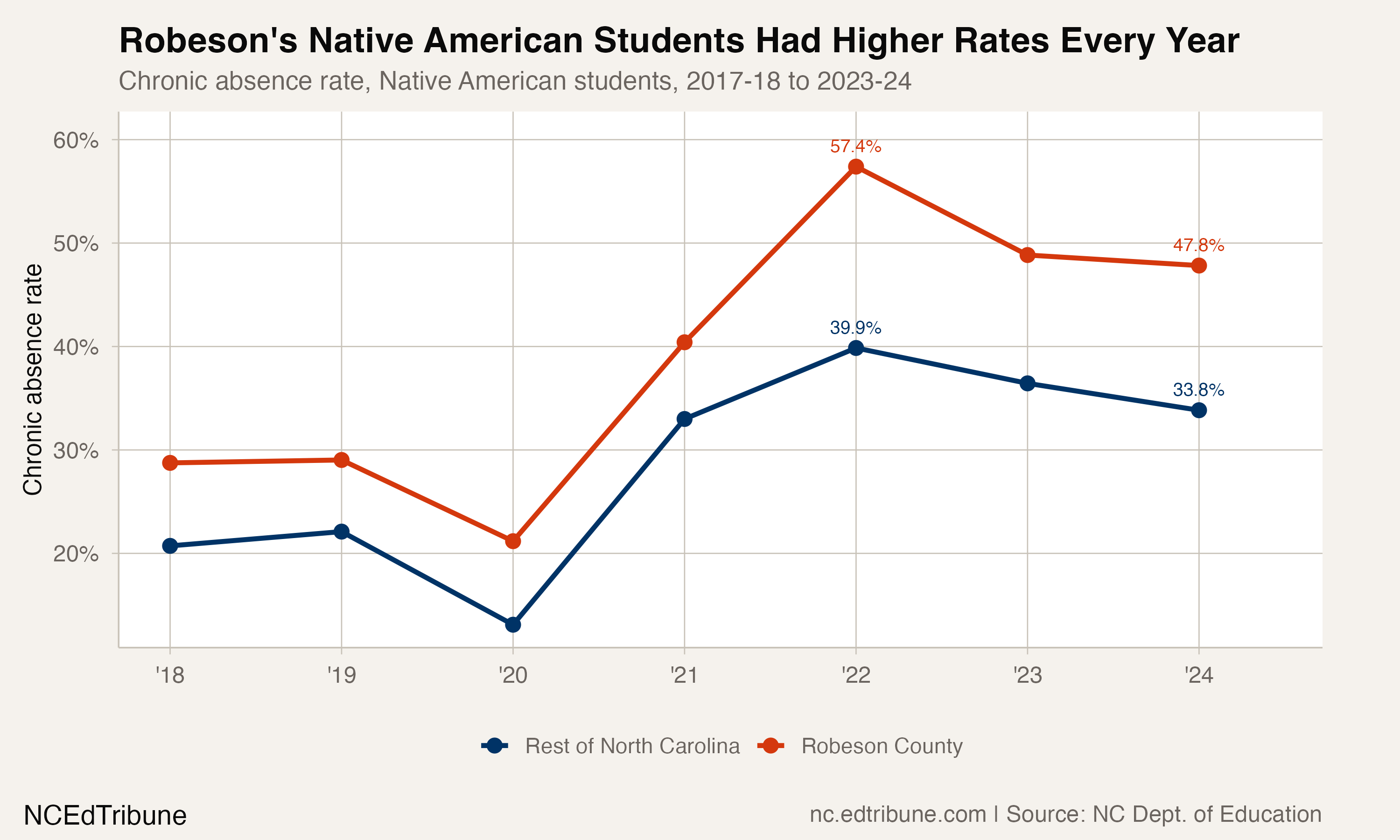
Native American students in Robeson County had a higher chronic absence rate than Native American students elsewhere in North Carolina in every year from 2017-18 through 2023-24. In Robeson, the rate was 29.0% in 2018-19, reached 57.4% in 2021-22, when a majority of the district's Native American students were chronically absent, and was 47.8% in 2023-24.
For the other roughly 7,600 Native American students in the state's cohort, the 2023-24 rate was 33.8%. That is about 14 points below Robeson's rate, and still about 14 points above the rate for white students statewide.
Outside Robeson, the rates vary more than the statewide figure suggests. Of the five districts with the next-largest Native American cohorts, four had rates of 40% or more in 2023-24. Scotland County Schools↗ET, adjacent to Robeson, counts about 850 Native American students, and 40.4% of them were chronically absent. Cumberland County Schools↗ET, with about 650, was at 41.2%; Hoke County Schools↗ET, with about 620, at 46.8%; and Swain County Schools↗ET in the western mountains, with about 330, at 48.3%. The exception was Wake County Schools↗ET, where 23.7% of about 370 Native American students were chronically absent, below the statewide rate for all students. The Lumbee Tribe identifies Robeson, Scotland, Hoke and Cumberland counties as its tribal territory and service area.
Robeson's Native American students also improved more. From 2021-22 to 2023-24, the rate for Native American students in Robeson fell 9.6 points, while the rate for Native American students in the rest of the state fell 6.0. Statewide, Native American students gained 7.8 points against 6.2 for all students, but their 2023-24 rate of 40.9% was still higher than the rate for all North Carolina students at the 2021-22 peak, 31.2%. The Lumbee Tribe won federal recognition in December 2025 after the attendance reporting window examined here, so none of these figures measure its effects.
A note on the numbers: North Carolina counts a student as chronically absent after they miss 10 percent or more of the days they were enrolled, and calculates the rate on students enrolled for at least 10 school days during the year. Native American student counts cited here are those chronic-absence cohorts. The rate for the rest of the state subtracts Robeson's published Native American counts from the state's published Native American counts.
Detailed code that reproduces the analysis and figures in this article is available exclusively to EdTribune subscribers.
Discussion
Sign in to join the discussion.
Loading comments...