In the 2021-22 school year, a majority of students in the Public Schools of Robeson County↗ET were chronically absent: 51.1%, or 11,047 of the 21,639 students in the state's chronic-absence cohort. In the state's data from 2017-18 through 2023-24, it is the only time any North Carolina district with at least 10,000 students crossed that line.
Two years later, in 2023-24, the rate was 40.7%. That 10.3-point drop was larger than the state's 6.2 points over the same years, though in proportional terms the two fell by about the same share, roughly a fifth. Robeson still had the highest chronic absence rate of the state's 37 districts with at least 10,000 students in 2023-24, the latest year of state attendance data available for this analysis, nearly 16 points above the state average. The district enrolled about 20,600 students in 2025-26, spread across 949 square miles of mostly rural southeastern North Carolina.
Asked what was working, Sheri Dial Herndon, the district's director of student services, pointed first to staffing. "Each school in the district has at least one school social worker assigned to the school," Herndon wrote in response to questions from The NCEdTribune in April. Over the past three years, she wrote, those social workers have focused on the root causes of chronic absence at their schools and worked with families to reduce the barriers that affect attendance. School teams work from a multi-tiered system of supports, known as MTSS: "When school teams problem solve using the MTSS framework, they are able to identify those students who are chronically absent and provide interventions to support the students and families." Much of the period she describes comes after 2023-24, the latest year of state attendance data, so the figures here cannot yet show whether that work moved the rate further.
Above the state in every year of the data
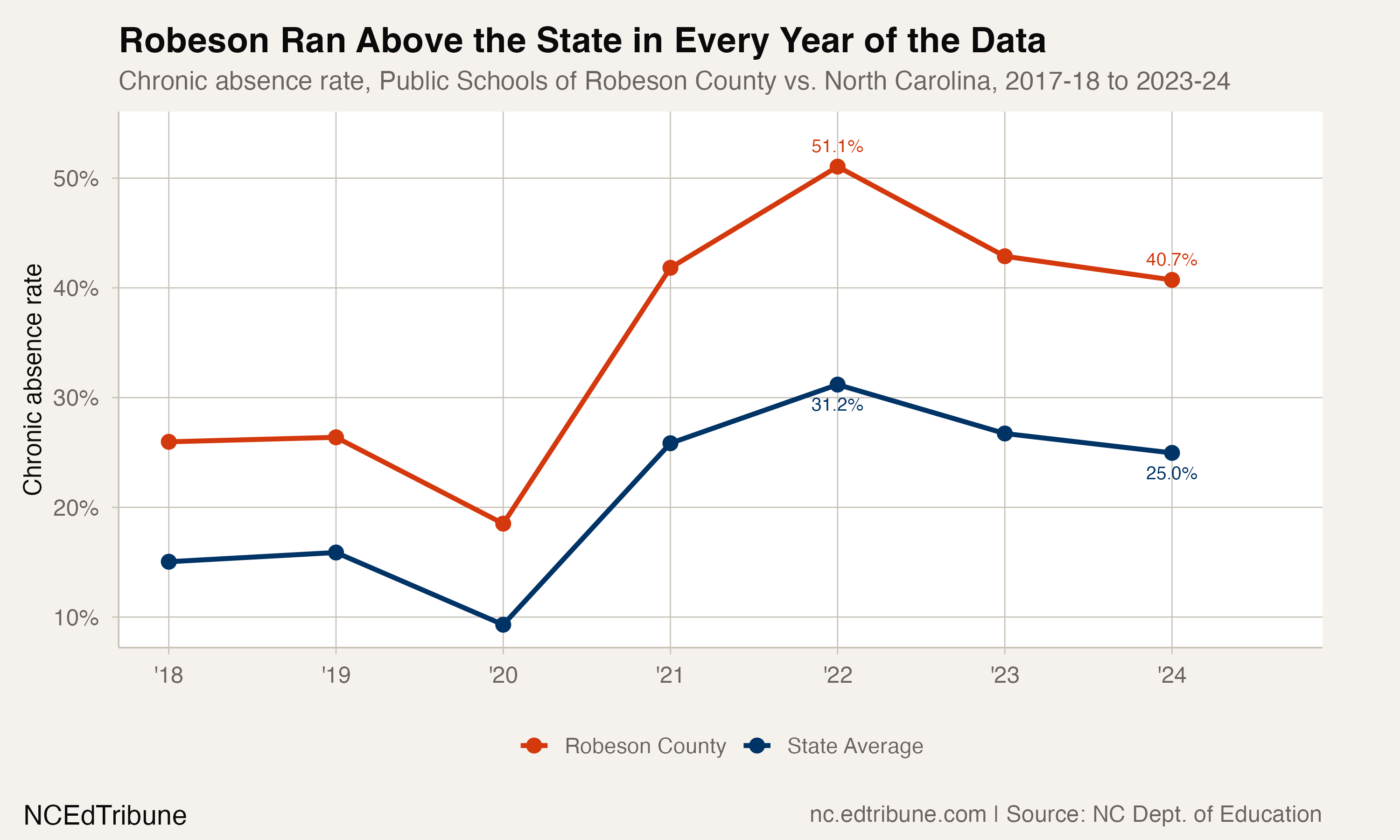
The gap between Robeson County and the state average ranged from 9 to 20 points across the seven years of data, and has been above 15 points in every year since 2020-21. Before COVID, in 2018-19, Robeson's chronic rate was 26.4% when the state was at 15.9%. At the 2021-22 peak, it was 51.1% when the state was at 31.2%. In 2023-24 it was 40.7% while the state was at 25.0%.
Measured as a ratio, the relationship has moved less than the gap in points suggests. Robeson's rate was 1.7 times the state's in both 2017-18 and 2018-19, and has run about 1.6 times the state rate every year since 2020-21. The pandemic raised Robeson's rate and the state's by similar proportions. The data do not show why Robeson started higher.
Asked whether the county's size and rural geography were the biggest single factor, Herndon pointed instead to poverty. "Poverty is one of the biggest levers impacting student attendance, especially in a county with the highest poverty within the state," she wrote in written answers to The NCEdTribune, and she described geography, housing situations and other circumstances as subfactors the district works to identify within it.
8,774 students in 2023-24
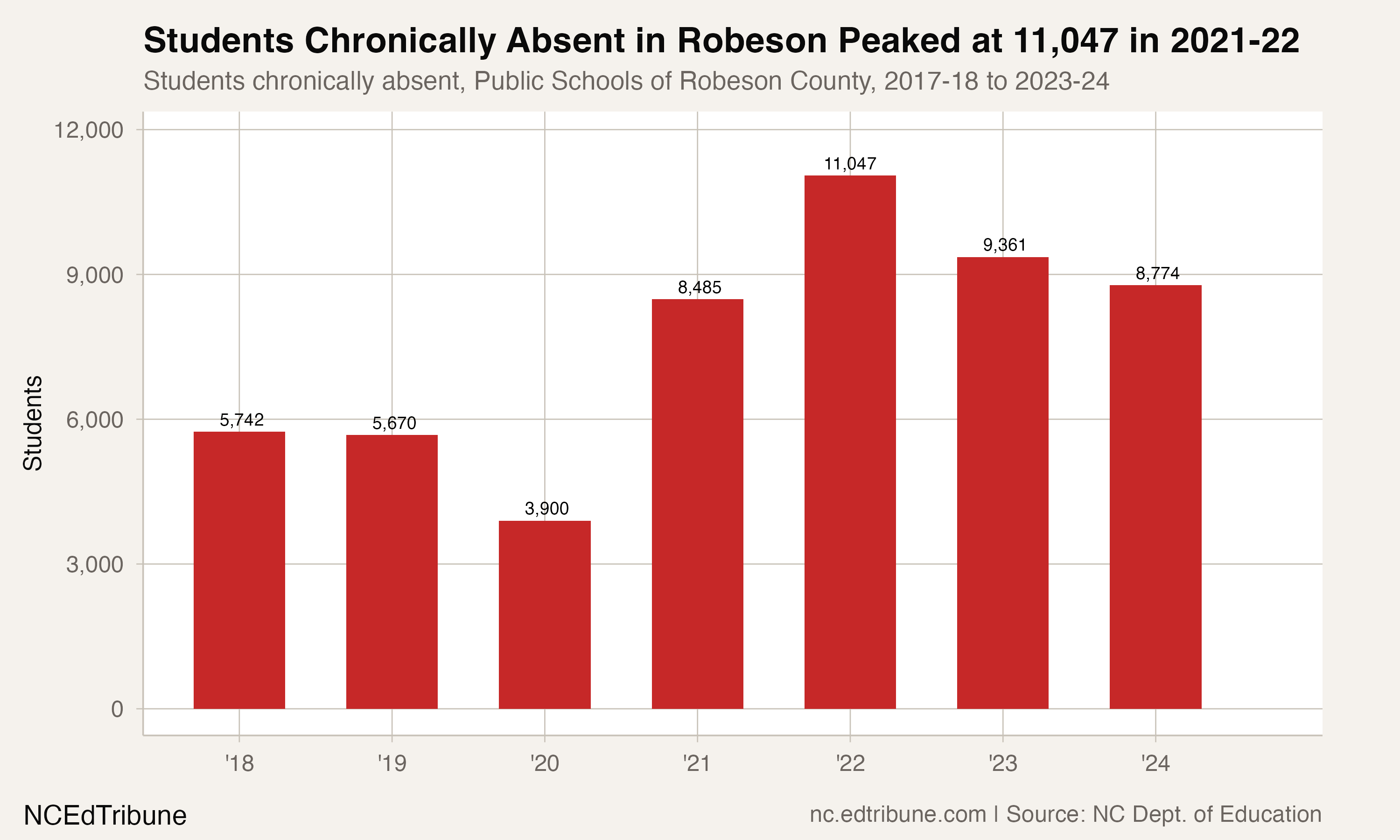
The 8,774 Robeson students who were chronically absent in 2023-24 made up 2.2% of the state's total, from a district with 1.4% of the state's chronic-absence cohort.
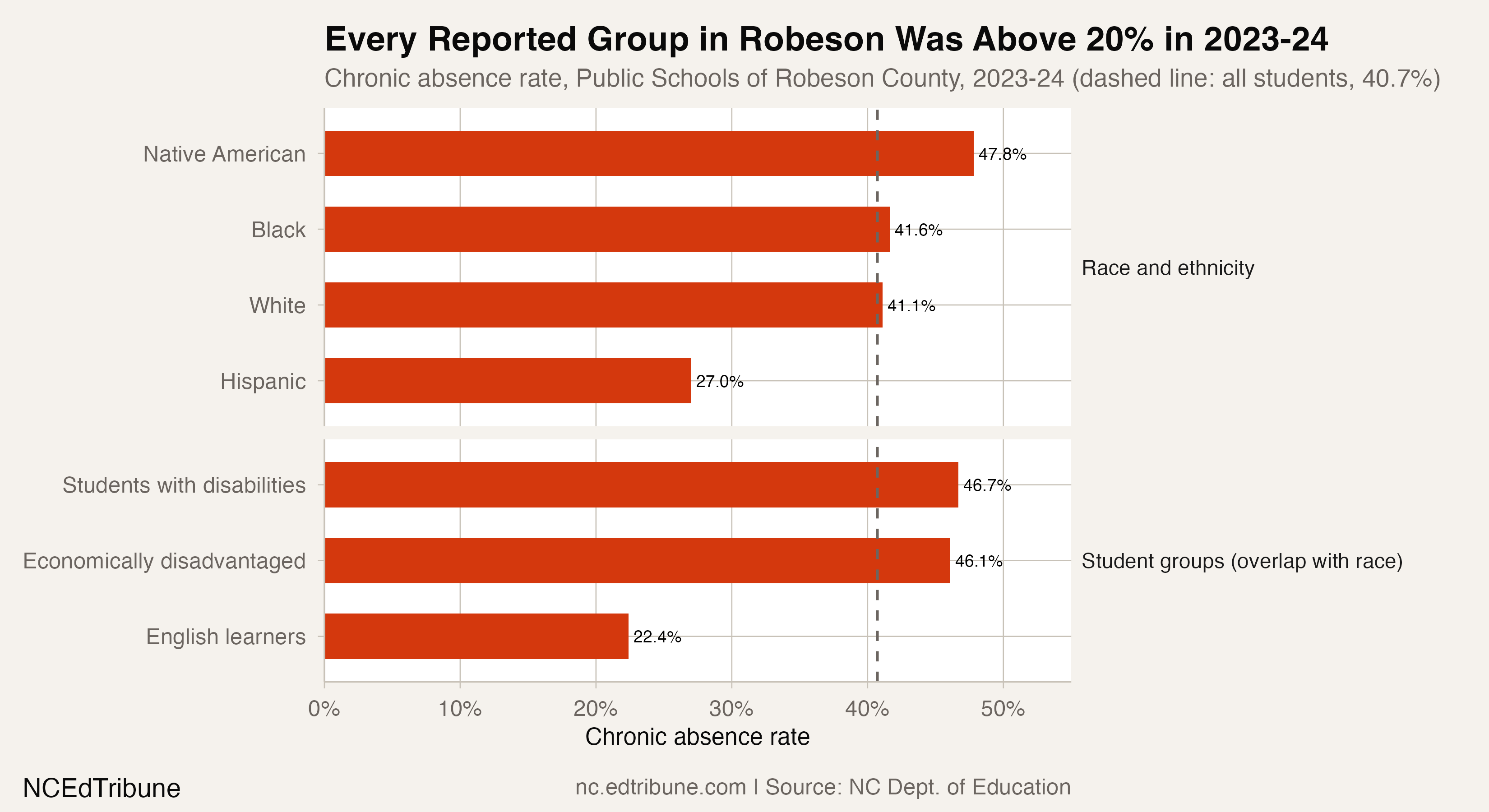
By race and ethnicity, Native American students had the highest rate in the district, 47.8%, followed by Black students at 41.6% and white students at 41.1%. Robeson's white students were chronically absent at about twice the 19.9% rate for white students statewide. Hispanic students were at 27.0%, slightly below the 28.4% statewide rate for Hispanic students.
Among student groups that overlap with race, students with disabilities had a 46.7% rate and students who are economically disadvantaged 46.1%. English learners, at 22.4%, had the lowest rate of any reported group in the district, well below the 28.8% rate for English learners statewide.
Among districts its size
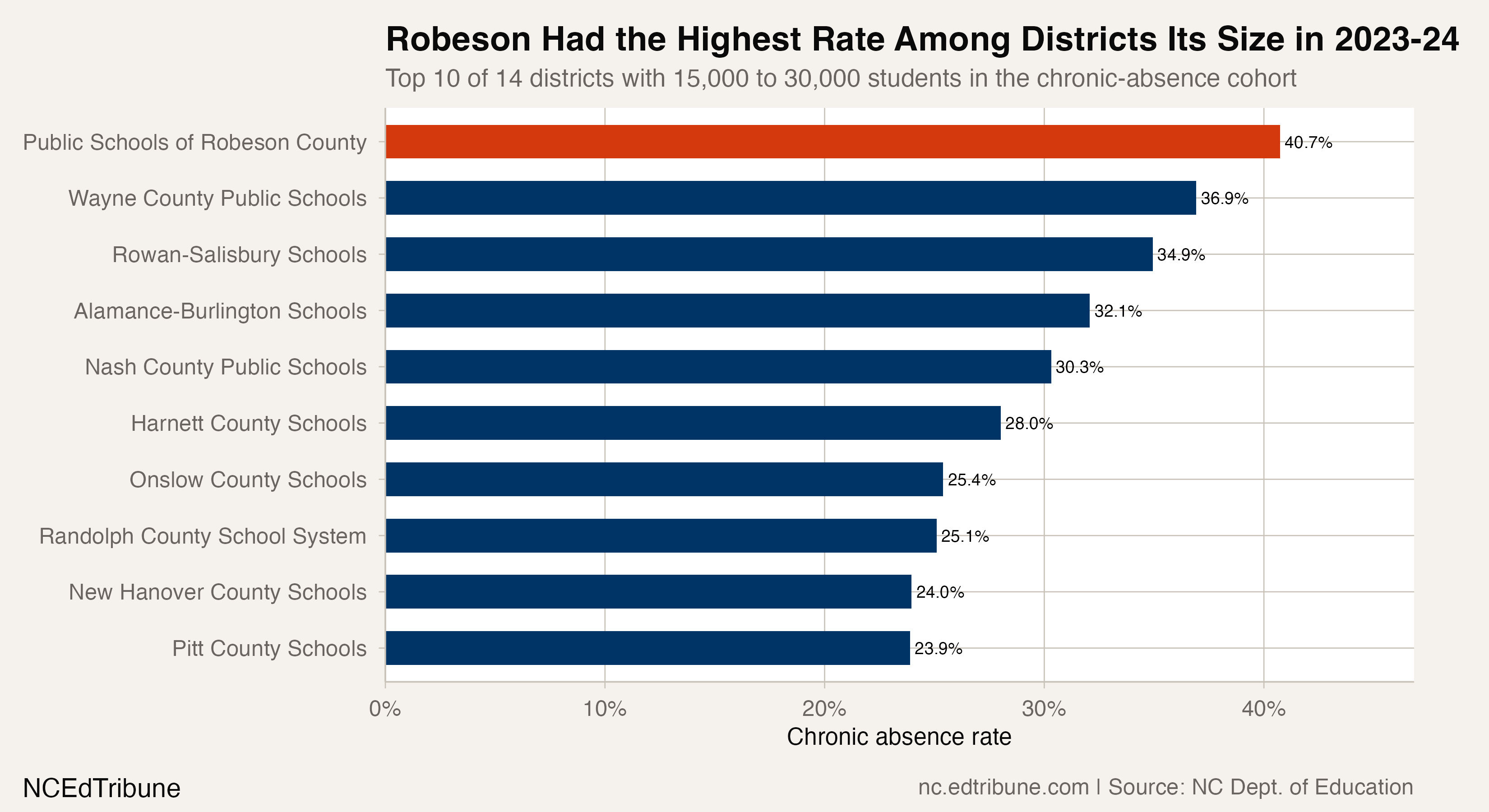
Among the 14 districts with 15,000 to 30,000 students, Robeson's 40.7% chronic rate was the highest in 2023-24, 3.8 points above the next highest. That was Wayne County Public Schools↗ET, at 36.9%, the only other district in the group above 35%.
Robeson County is home to the Lumbee Tribe, which won federal recognition in December 2025 after a 137-year campaign. Recognition makes the tribe eligible for Bureau of Indian Affairs funding, including support for housing, education and health care. Recognition came to the county with the highest chronic absence rate of any large North Carolina district in the most recent state data.
The district and the tribe already work together. In written answers to The NCEdTribune, Herndon wrote that representatives of both collaborate to build connections among students and families, sharing resources such as tutoring, food and housing programs, and coordinating grant-funded programs for identified groups of students. She named the district's Indian Education Program and the tribe's Project CREATE as "tribal programs that offer services such as tutoring, financial support, and cultural activities as a means to improve educational opportunities and outcomes for our students." With recognition and "possible new federal resources in the future," she wrote, the district "will continue to partner with the Lumbee Tribal leadership to identify the specific needs of the schools, students, and community related to chronic absenteeism and establish programs and interventions to address concerns with a goal to reduce chronic absenteeism among our schools."
A note on the numbers: North Carolina counts a student as chronically absent after they miss 10 percent or more of the days they were enrolled, and calculates the rate on students enrolled for at least 10 school days during the year. Student counts tied to a rate here are that rate's own cohort. The district's overall enrollment of about 20,600 comes from the state's 2025-26 membership data, which counts students differently.
Detailed code that reproduces the analysis and figures in this article is available exclusively to EdTribune subscribers.
Discussion
Sign in to join the discussion.
Loading comments...